UniRankDex
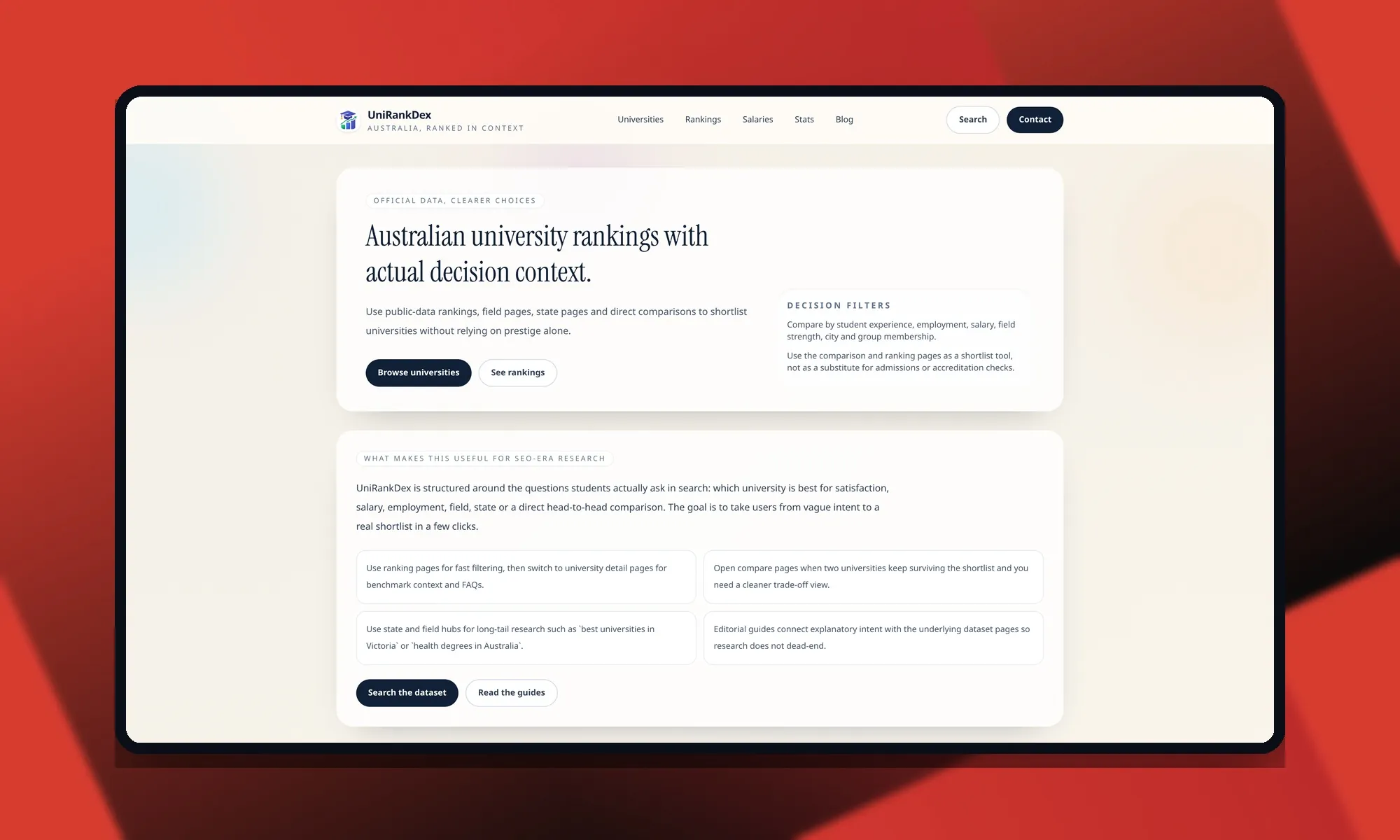
Directory and ranking of all 41 Australian universities built on official public data — satisfaction, employment, salaries and employer perception — with 820 head-to-head comparison pages generated through programmatic SEO. An own product I designed, built and operate.
Why it exists: choosing a university on data, not marketing
Traditional league tables measure prestige. UniRankDex, one of the products in my own network of sites, attacks the decision from a different angle: where are students most satisfied? Which graduates find work fastest? Which universities pay best straight out of the gate? All of it built on official Australian public indicators, not opinions.
The platform is structured around the questions a student actually types into a search engine — best university for satisfaction, for salary, by field of study, by state, or the head-to-head between two specific options — and takes them from vague intent to a genuine shortlist in a few clicks.
Beyond being a product in its own right, it is my programmatic SEO lab: the page-generation techniques I test here at scale are the same ones I later apply on client projects.
What it lets you do
- Outcome-based rankings. National leaderboards for student satisfaction, graduate employment, starting salaries and employer ratings.
- A profile for every university. Each institution gets its own detail page with benchmark context, FAQs and its metrics set against the national average.
- 820 head-to-head comparisons. Direct comparison pages for when two universities survive the shortlist and you need to see the trade-off cleanly.
- State and field hubs. 8 state hubs plus field-of-study pages for regional long-tail searches.
- Decision filters. Student experience, employment, salary, strength by field, city and membership of groups such as the Group of Eight.
- Editorial guides. Articles that connect informational intent to the data pages, so research never dies in a dead end.
How it is built
1. Laravel architecture
- Laravel + PHP backend with MySQL. Every page type — profile, ranking, comparison, state hub, field of study — is its own Blade view fed by the same dataset. No prefab templates, no plugins.
- Clean per-entity routes (
/university/{slug},/ranking/{metric}…) that map one-to-one to the search intents they target. - Assets compiled with Vite and minimal JavaScript — Alpine.js only where interactivity is needed, such as navigation.
2. Data pipeline
- Normalised dataset in MySQL: five outcome indicators per university plus context metadata (state, city, founding year, student numbers, university group).
- Rankings computed from the dataset, not written by hand: when the public source data is updated, positions and comparisons recompute in cascade.
- Benchmarks on every profile: each university shows its metrics against the national average, so an 89% employment figure means something without leaving the page.
3. Programmatic SEO
- 820 unique comparison pages that must read like natural editorial, not a cloned table — the project's specific technical challenge.
- State and field hubs that capture the regional long tail ("best universities in Victoria", "health degrees in Australia").
- Structured data on every page: Organization, WebSite with SearchAction and FAQPage generated automatically from the dataset.
- An editorial blog that links informational intent to the data pages and spreads internal authority.
4. Performance
- Server-rendered HTML: the data pages do not depend on JavaScript to render or to get indexed.
- Preload and modulepreload of critical CSS and JS to shorten the initial render.
- Cloudflare in front as CDN and anti-bot layer, shielding the server from the aggressive scraping every data directory attracts.
Coverage and data provenance
Coverage is complete: all 41 registered Australian universities, organised into 8 state hubs and field-of-study pages. For each institution, five outcome metrics are tracked, all sourced from official public data: student satisfaction, graduate employment, starting salary, employer perception and enrolment volume.
The current leader illustrates the level of detail: The University of Melbourne, ranked number 1, with 91.80% satisfaction, 89.40% employment, a median starting salary of 78,200 AUD and 61,200 students. UniRankDex does not replace official admissions channels — it is the shortlisting tool that was missing before you get to them.
The outcome
From a single well-modelled dataset come more than 870 useful pages: 41 profiles, 820 comparisons, 8 state hubs, national rankings and field pages — each answering a specific search with verifiable data. No CMS, no copywriters cloning tables, and not a single page touched by hand when the data changes.
It is the showcase of what I stand for as a developer: model the data well, write good templates and let the architecture scale the content. What here are universities, on a client project are clinics, insurers, properties or products.
A few screenshots
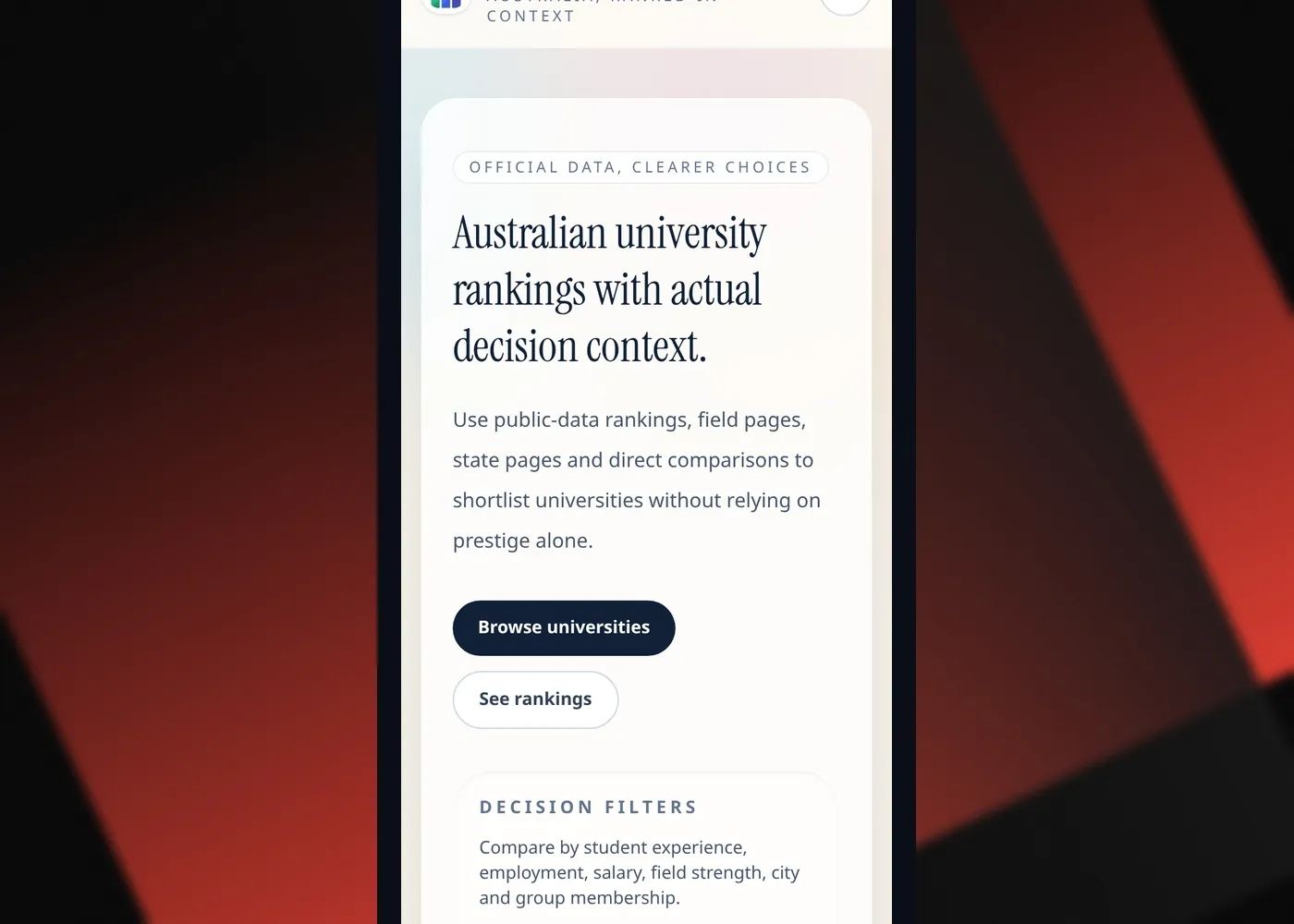
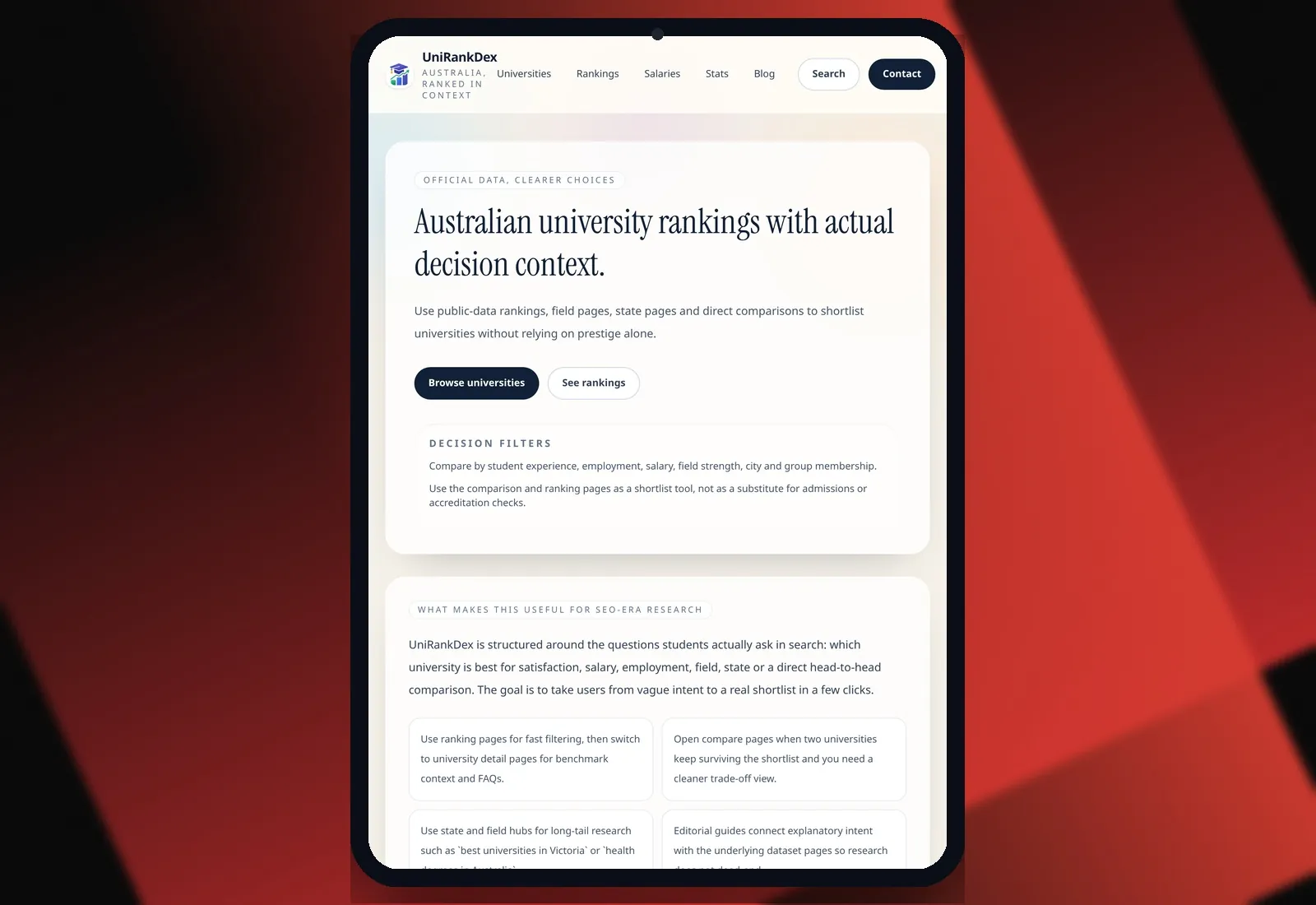
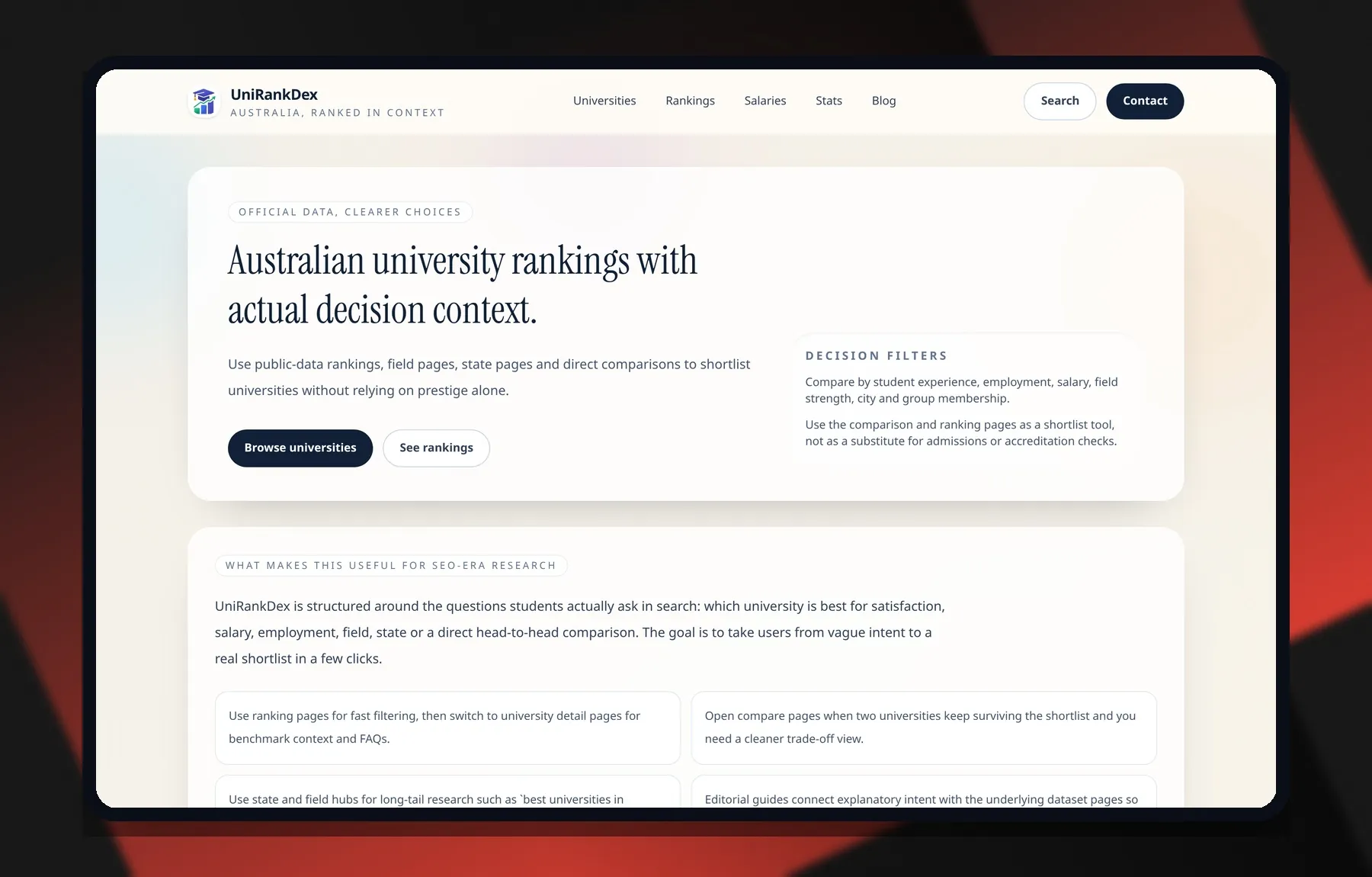
Stack
Project website: Visit unirankdex.com — own product in production.
Common questions about UniRankDex
What data does UniRankDex use to rank universities?
Official Australian public data: student satisfaction, graduate employment, starting salary, employer perception and enrolment. The whole point is to rank on measurable outcomes rather than brand prestige alone.
How many universities and comparisons does the platform cover?
All 41 registered universities in the country, with 820 head-to-head comparison pages, 8 state hubs and field-of-study pages for searches like "best universities in Victoria" or "health degrees in Australia".
Does UniRankDex replace international rankings or official guidance?
It does not try to. It is designed as a shortlisting tool: you filter with the rankings, cross-check on each university profile and open the comparison pages when two options survive your shortlist. Admissions and accreditation checks remain a matter for the official channels.
Which university leads the ranking?
In the current dataset, The University of Melbourne sits at number 1, with 91.80% student satisfaction, 89.40% graduate employment and a median starting salary of 78,200 Australian dollars.
Can you filter by city or by groups like the Group of Eight?
Yes. The decision filters cover student experience, employment, salary, strength by field of study, city and membership of university groups such as the Group of Eight.
What technology is UniRankDex built with?
A Laravel backend with PHP and MySQL, server-rendered Blade views and assets compiled with Vite, all served behind Cloudflare. Every page type — profile, ranking, comparison, hub — is its own template fed by the same dataset.
Other own products in Australia
Sister platforms built on Australian public datasets.
Need a directory or comparison site like this?
Custom Laravel, well-modelled datasets and programmatic SEO that scales to hundreds of pages. Free 30-minute call, no strings attached.
Request a free quote