SchoolScan AU
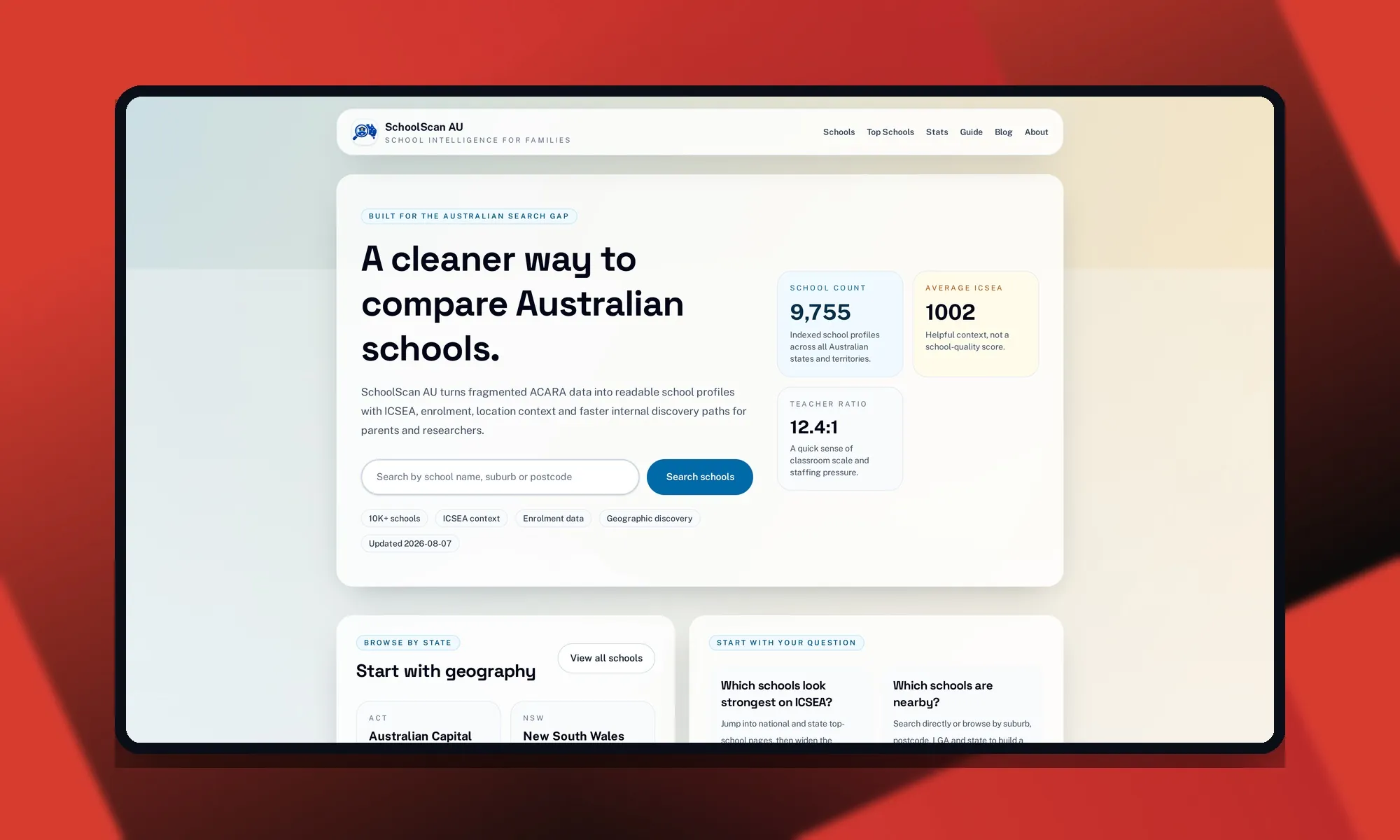
A directory of Australia's 9,755 schools built from public ACARA data: ICSEA, enrolment and local context in profiles families can actually read. An own product from my network of sites, built with Laravel, MySQL and programmatic SEO.
Why it exists: excellent official data, terrible reading experience
Choosing a school in Australia means wrestling with fragmented official data: the ICSEA socioeconomic index on one side, enrolment figures on another, sectors and school types in separate tables that ACARA publishes with statisticians in mind, not families. The information exists and it is good — what did not exist was a reasonable way to read it.
I built SchoolScan AU as an own product within my network of sites to close that gap: a single profile per school, written for the person making the decision, with navigation paths that start from the real question — "which schools are near me and how do they compare?". The platform serves parents preparing a move or a change of stage, and also researchers who need to walk the school system geographically. A guide hub explains how to interpret ICSEA correctly before comparing anything: it is a context indicator, not a quality score, and the site insists on that on every page.
It pairs with SchoolScan CA, the sister version for Canada: the same product model applied to a different education system and a different official data source.
What it lets you do
- Search by name, suburb or postcode, the natural entry point for a family.
- Full geographic browsing: state, suburb and LGA, with real school counts and enrolment per area.
- Sector comparison: 6,811 Government schools, 1,694 Catholic and 1,250 Independent.
- School-type filtering: 6,229 Primary, 1,515 Secondary, 1,480 Combined and 531 Special education schools.
- Top Schools and national statistics pages with the sector mix and the highest-ICSEA profiles.
- Question-driven paths from the home page: schools nearby, strong-ICSEA schools, how to read the data, the national picture.
- A guide hub and blog for interpreting ICSEA, enrolment and context before deciding.
How it is built
1. Laravel architecture
- Laravel + PHP 8 on MySQL, with a data model that joins school, suburb, LGA, state, sector and type without duplicating information.
- Frontend with Tailwind CSS and Alpine.js compiled with Vite: minimal, deliberate interactivity, with no heavy client-side frameworks.
- Purpose-built templates per page type: school profile, state hub, suburb, sector, type, top schools and statistics, each with its own structure and data.
2. ACARA data pipeline
- Ingestion of public ACARA data — the Australian curriculum and assessment authority — normalised into a custom schema.
- Aggregates computed per entity: school counts, total enrolment and average ICSEA per state, suburb, LGA, sector and type, served on every browsing page.
- Updates with a visible date: the home page shows when the data was last refreshed.
3. Programmatic SEO
- Thousands of indexable URLs generated from the database: one per school plus the combinations of state, suburb, LGA, sector and type.
- Unique titles, descriptions and Open Graph tags per page, built from each entity's real data.
- Structured data (Organization, WebSite with SearchAction and FAQPage) so search engines and answer engines understand the site.
- Natural interlinking: every profile links to its suburb, its state, its sector and its local alternatives, so authority circulates on its own.
4. Performance
- Server-rendered pages that load in a fraction of a second, without waiting on JavaScript to paint the content.
- Versioned assets and a Cloudflare CDN in front, which also filters automated traffic.
- Zero prefab templates or third-party plugins: all of the page weight is content.
Coverage and data source
Coverage spans the country's 8 states and territories: from New South Wales (3,196 schools and over 1.25 million enrolments) and Victoria (2,310 schools) down to the Northern Territory (194) and the Australian Capital Territory (139). Each state hub shows its totals for schools, enrolment and average ICSEA — and that is where the value of context shows: average ICSEA runs from 794 in the Northern Territory to 1082 in the capital, a gap no flat ranking would tell well.
All of the information comes from public ACARA data. SchoolScan AU invents nothing and scores nothing: it restructures the official source into comparable profiles and explains how to read it.
The result
SchoolScan AU is live at schoolscan-au.com with all 9,755 indexable profiles, growing organically the way that works best for directories: thousands of useful pages answering specific searches ("schools in X suburb", "Catholic schools in Y state") without buying a single click. I design, build and operate the platform end to end: data model, code, SEO and content.
As a business case, it proves my favourite thesis: a well-structured public dataset + programmatic SEO = a digital asset that works on its own. The same pattern I apply to client projects with their own catalogues and data.
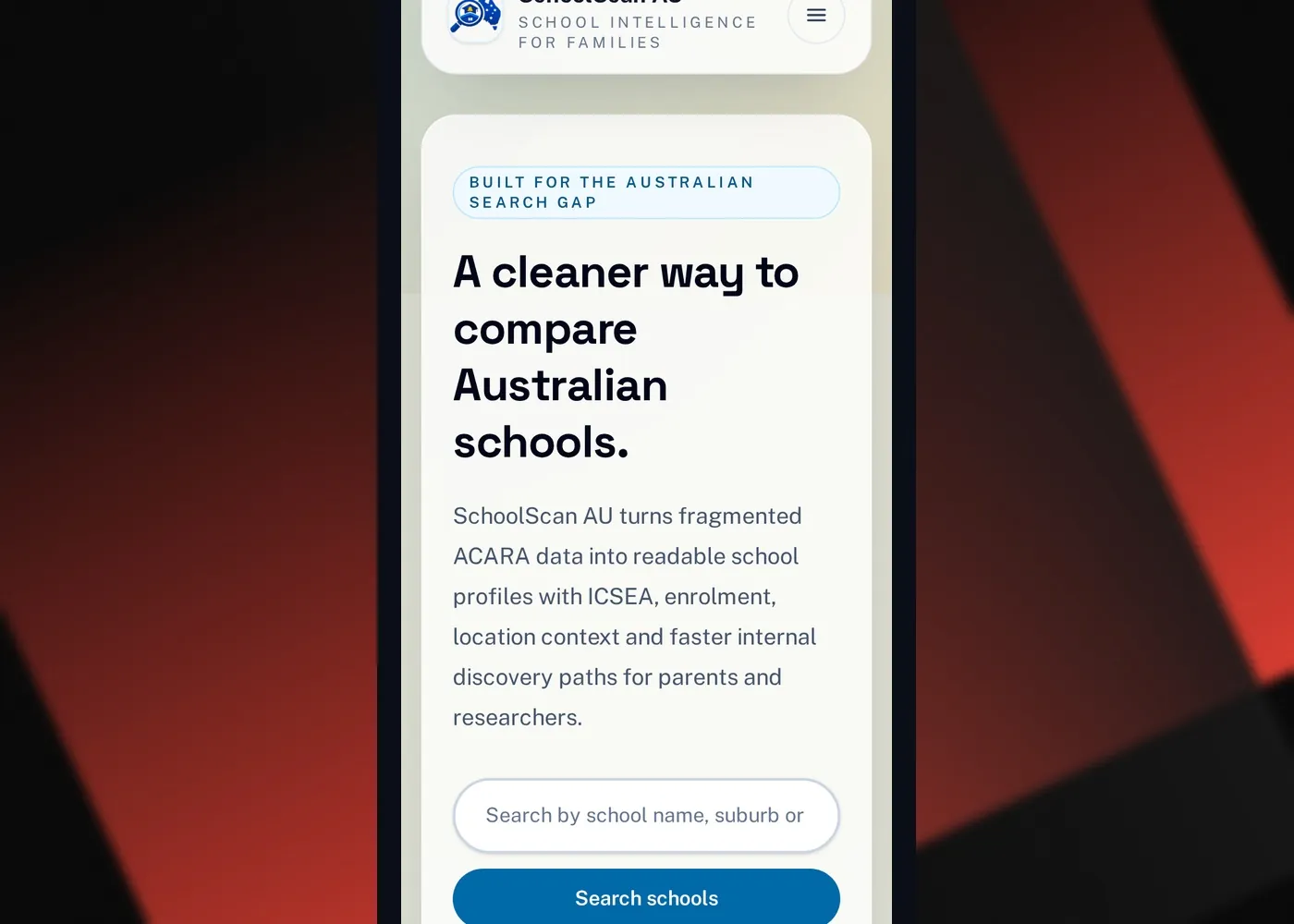
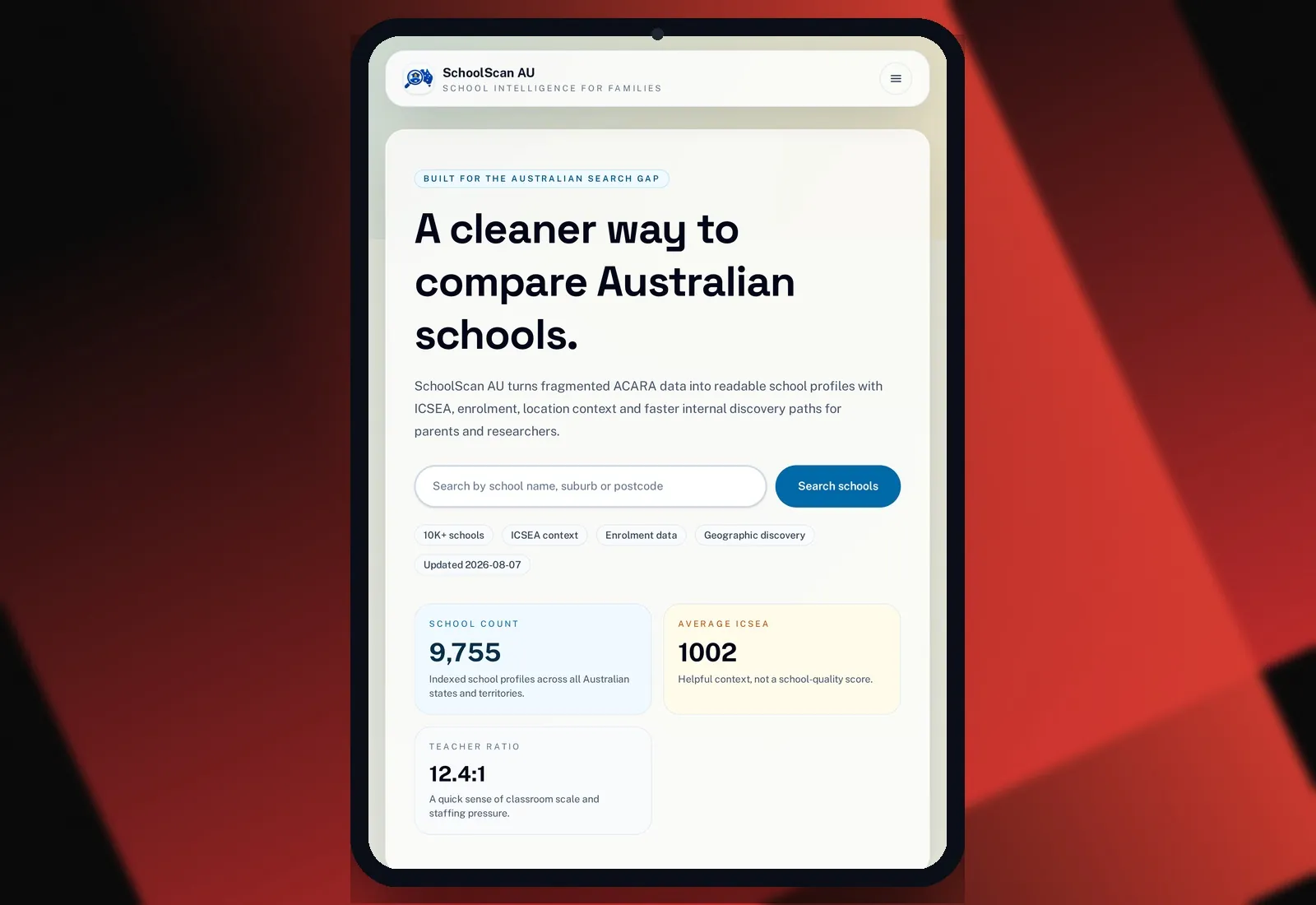
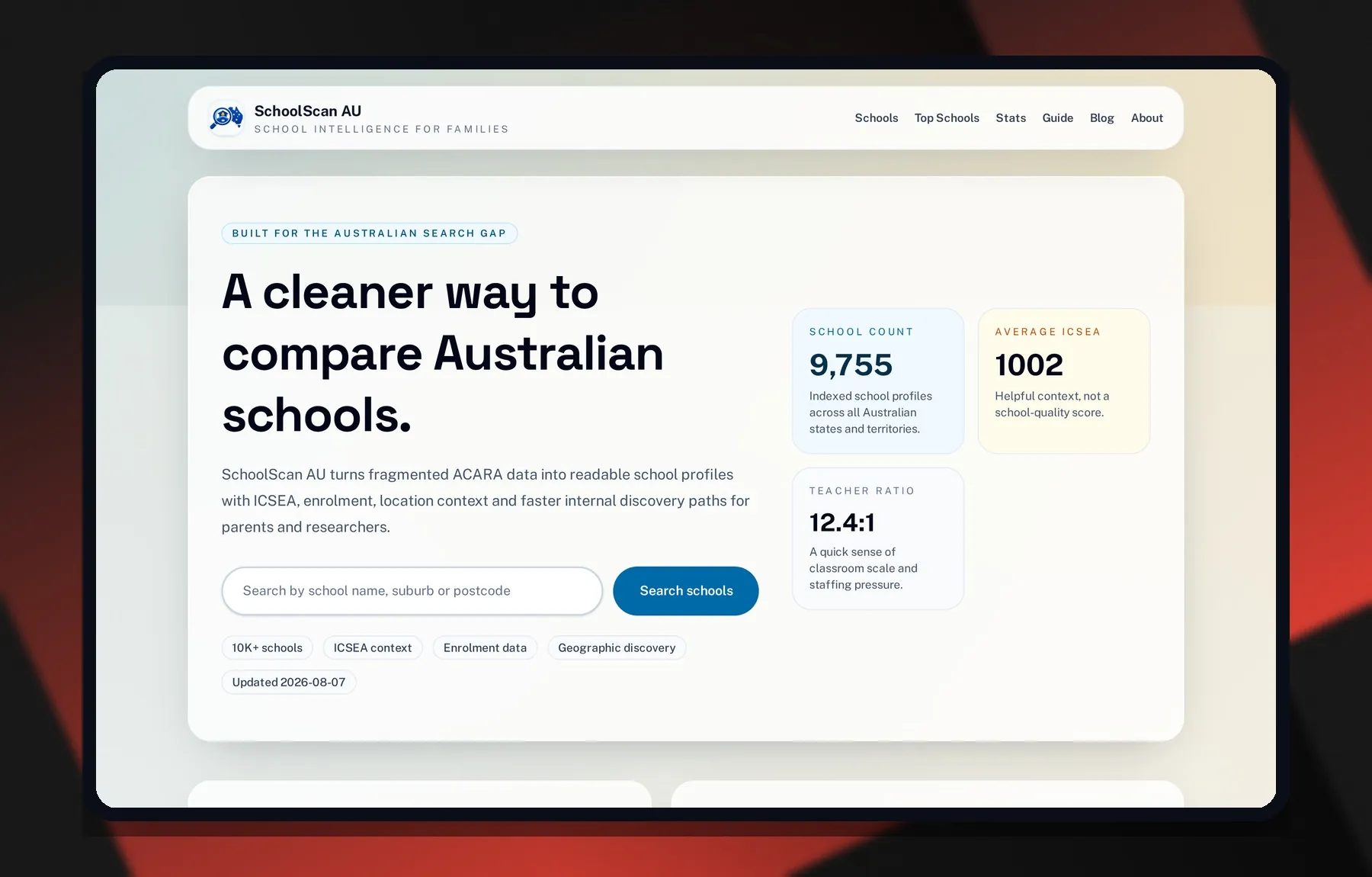
A few screenshots
Stack
In production: Visit schoolscan-au.com — an own product from my network of sites.
Questions about SchoolScan AU
How many schools does SchoolScan AU cover?
It indexes 9,755 school profiles covering every Australian state and territory, from 3,196 schools in New South Wales down to 139 in the Australian Capital Territory.
What is ICSEA and how does the platform treat it?
ICSEA is a socioeconomic index describing the context of each Australian school. SchoolScan AU always presents it as context, never as a ranking: the site itself insists on reading it alongside enrolment, school type and local alternatives.
Where does the school data come from?
From public ACARA data — the Australian Curriculum, Assessment and Reporting Authority. The platform restructures it into readable profiles with ICSEA, enrolment and location.
How do you browse the directory?
With a search box by school name, suburb or postcode, plus browsing by state, suburb, LGA, sector (Government, Catholic, Independent) and type (Primary, Secondary, Combined, Special).
What technology is SchoolScan AU built with?
Laravel and PHP on MySQL, with Tailwind CSS and Alpine.js on the frontend. Every school, state, suburb, sector and type page is generated from the database.
Is there a SchoolScan for other countries?
Yes. SchoolScan CA is the sister version for Canada: the same model, a different education system and a different official data source. Both are part of my own network of web products.
More of my own products
Got data that could become a platform?
Laravel, programmatic SEO and a well-designed data model. A 30-minute call, no strings attached.
Request a free quote