NDISScan
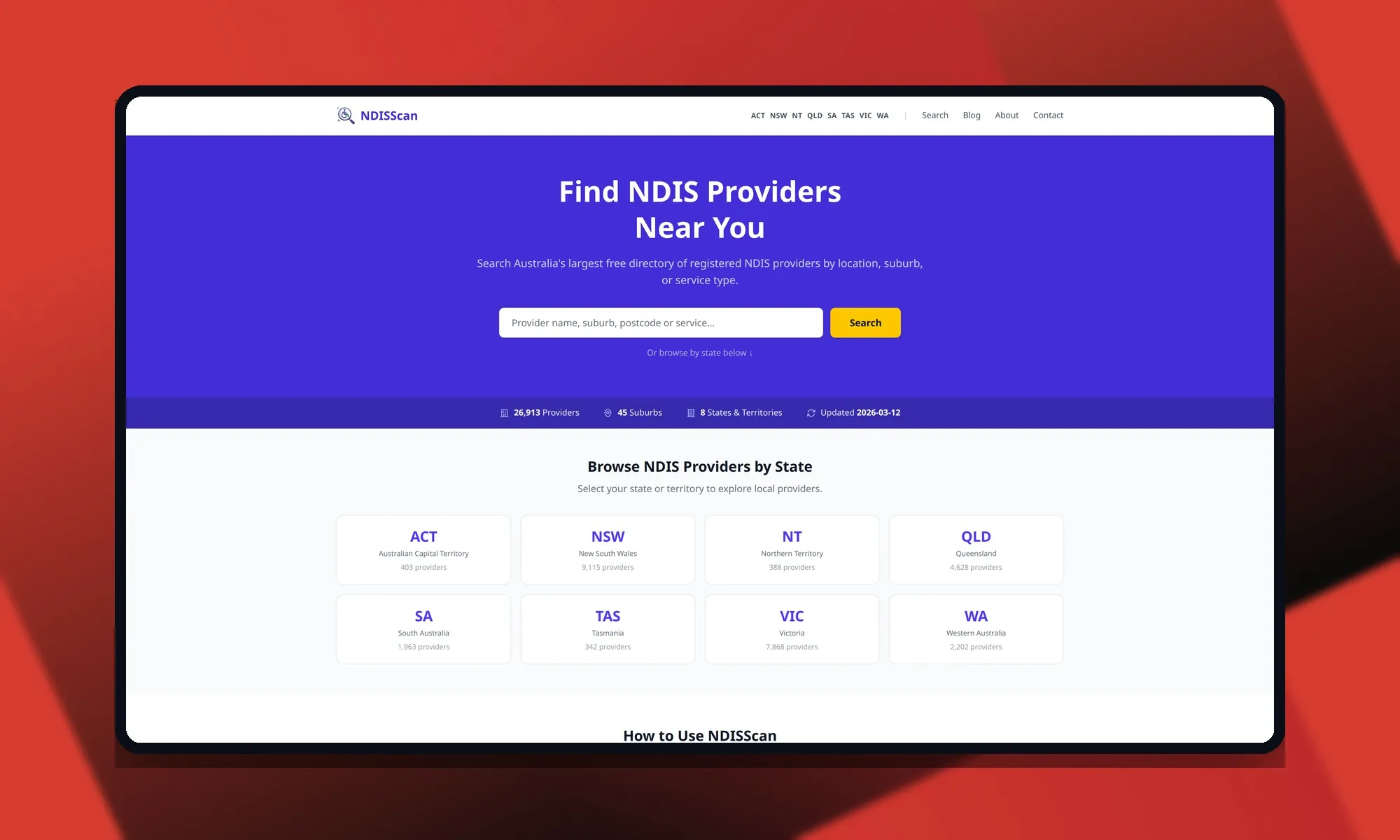
A national directory of the 26,913 registered providers of the NDIS, Australia's disability support scheme. Laravel + MySQL, programmatic SEO with one URL per provider, state and service, and a comparison tool for choosing with confidence. I designed it, built it and operate it as one of the products in my own network of websites.
Why it exists: choosing an NDIS provider is overwhelming
When an Australian family receives their NDIS plan, the next step is finding who will deliver those supports. With tens of thousands of registered providers and information scattered across websites, PDFs and hard-to-filter official listings, that choice turns into hours of searching. And the typical user is not technical: NDIS participants, family members and support coordinators need quick answers, not spreadsheets.
NDISScan condenses that entire universe into a single free directory: every provider has a profile with the services it is registered for, its location, its contact details and its registration status, all reachable from one search box with no account required.
It is a product of my own network of websites and tools: I spotted the gap, designed the architecture, built the platform and run it. There is no client behind it — the "client" is the digital asset itself, which lets me apply, friction-free, the same programmatic SEO playbook I use across the rest of my directories.
What it lets you do
- One search box that accepts a provider name, suburb, postcode or service category in the same field.
- Provider profiles with registered services, location, direct contact details and approval status on the NDIS register.
- Built-in comparison: two providers side by side to judge which one fits a specific plan before picking up the phone.
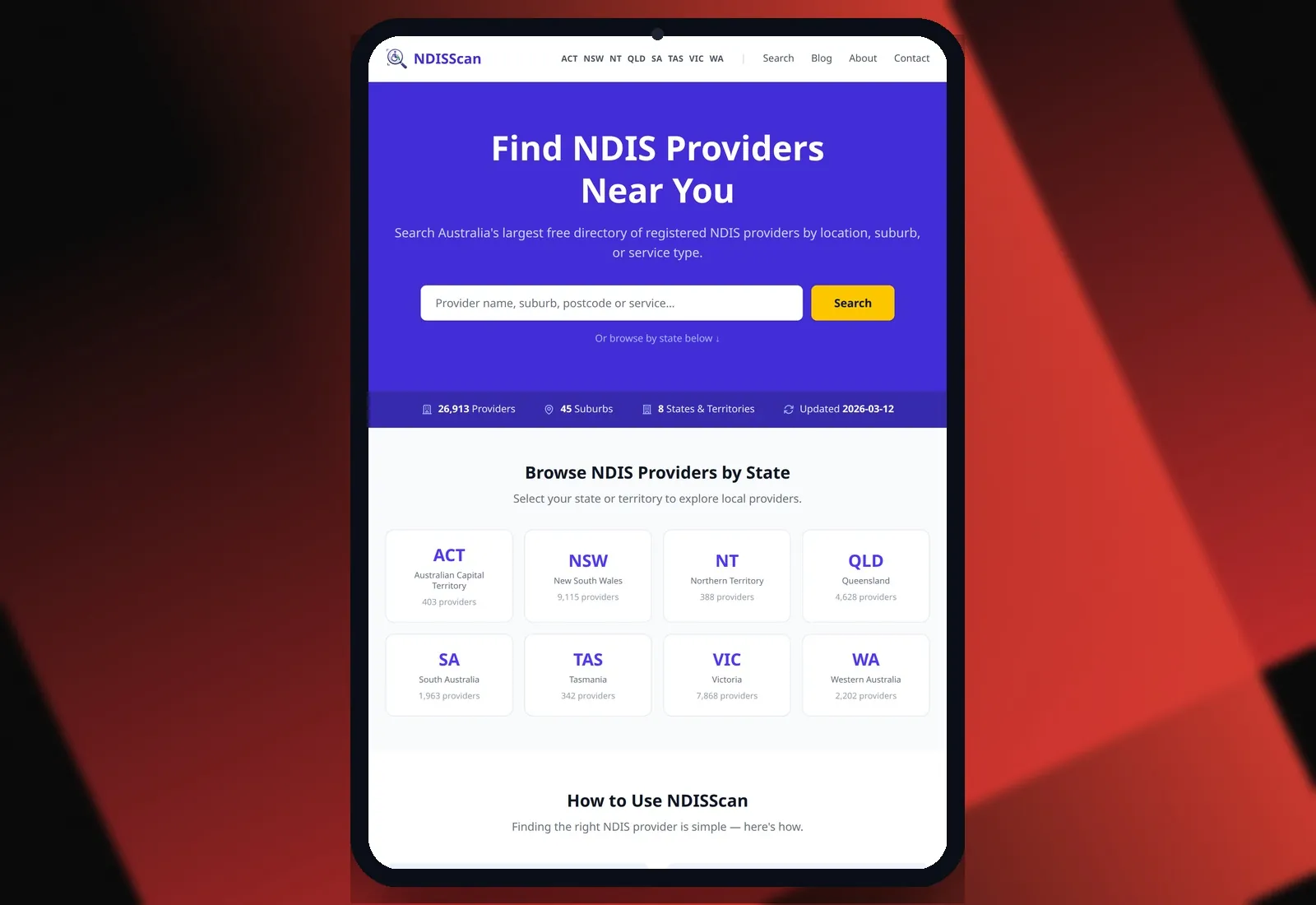
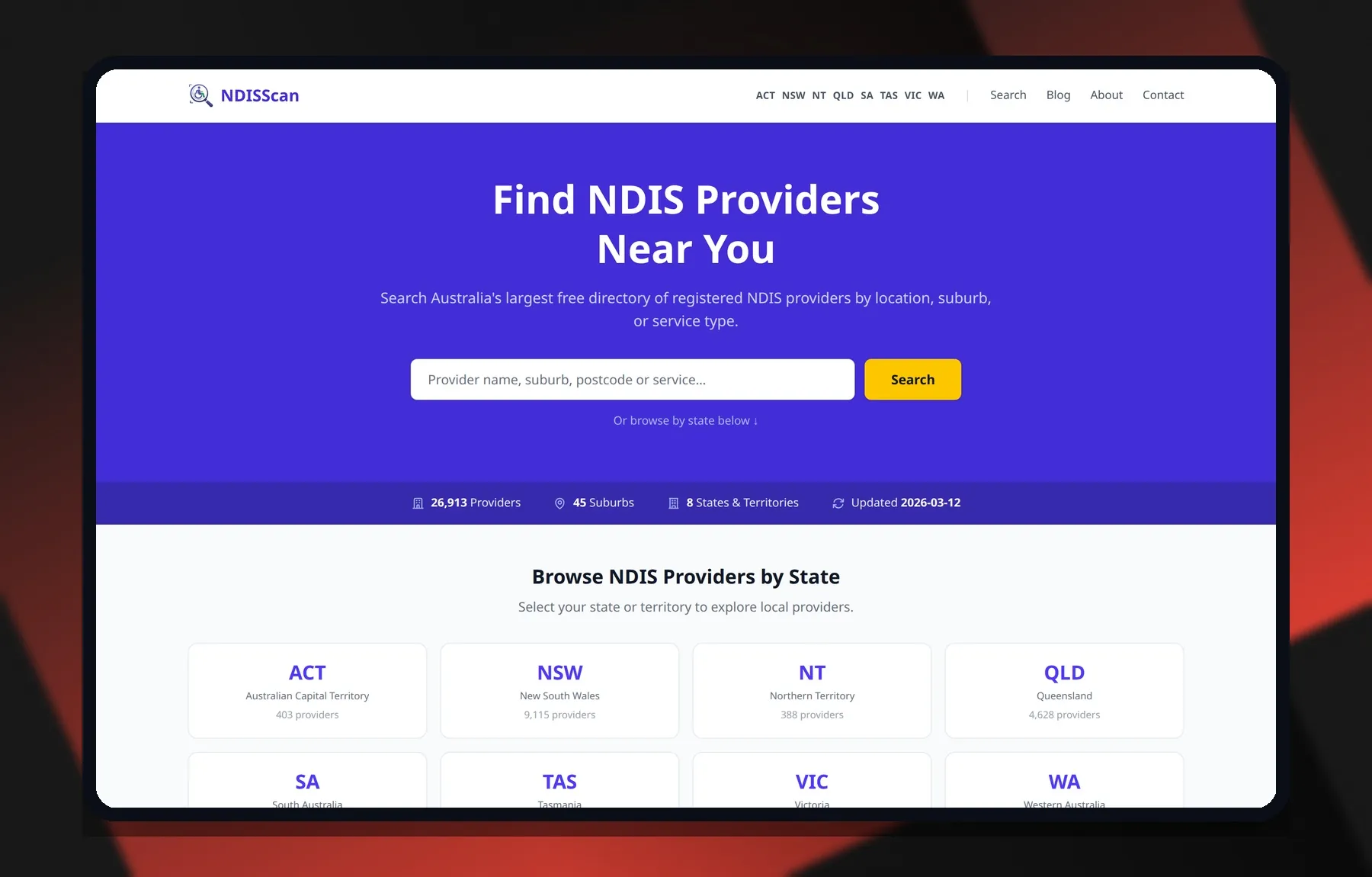
- State-by-state browsing across the 8 states and territories, from the ACT to Western Australia, each with its own provider count.
- NDIS service categories: household tasks (16,880 providers), community participation (16,233), assisted transport (15,949), assistance with personal activities (15,836), development of daily living and life skills (15,488) and assistance with shared living (15,124), among others.
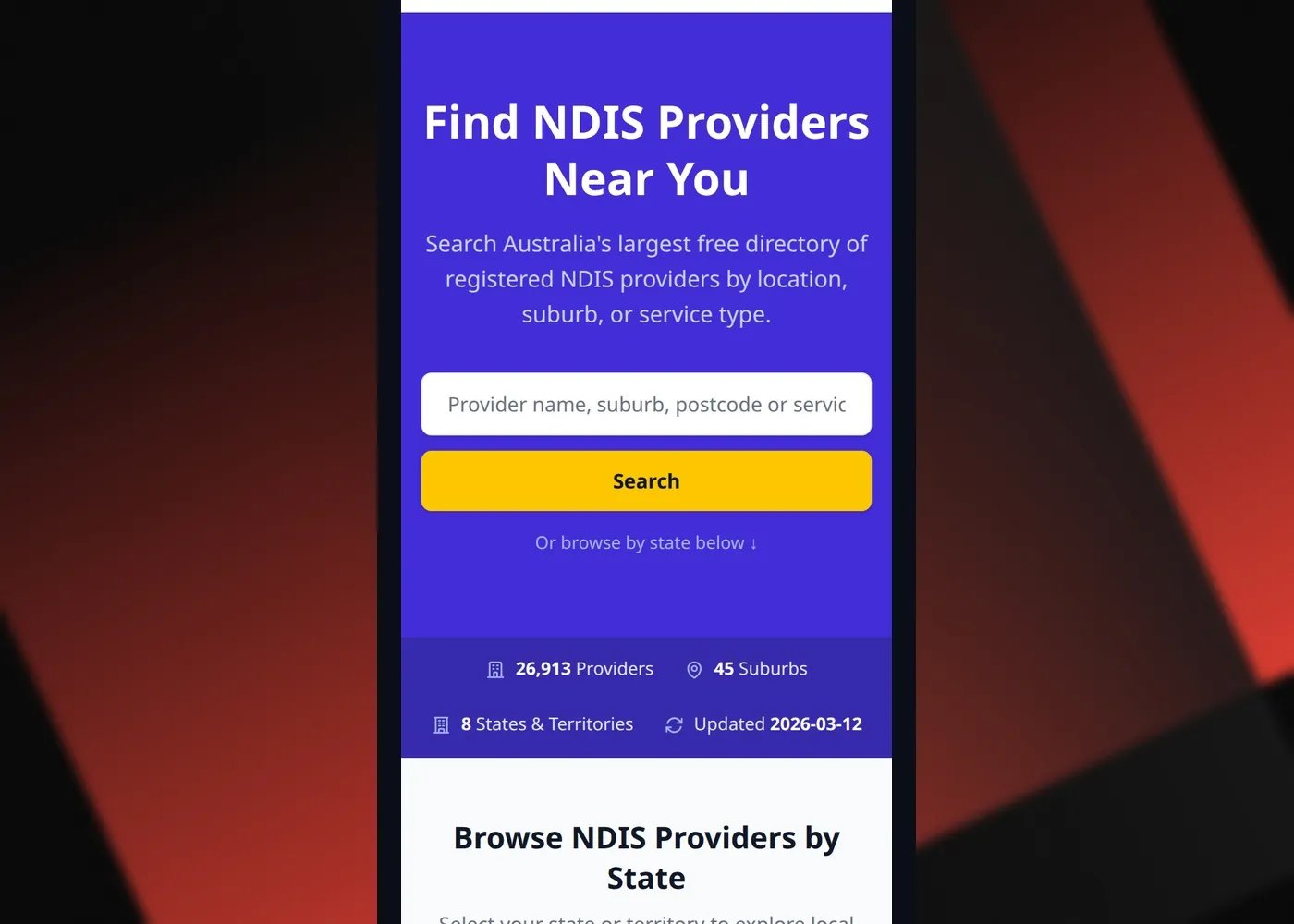
- A 4-step how-to guide — search, review, compare, contact — and a blog with guides for participants who are new to the scheme.
How it is built
1. Laravel architecture
- Laravel + PHP 8 with Blade templates and a MySQL database modelled for this exact dataset: providers, states, registration groups and their relationships. No generic CMS, no third-party plugins.
- Clean, hierarchical routes:
/provider/,/state/and/service/, designed for users and crawlers alike. - Tailwind CSS and Vite on the frontend: hash-versioned assets, server-rendered HTML and zero JavaScript dependency for the content.
2. Data pipeline
- Official source: the directory is built on the NDIS public provider register, imported and normalised into MySQL.
- Unique, stable slugs that combine the provider name with its registration identifier (e.g.
...-ndis0027589), so every profile keeps its URL across updates. - Aggregated counters per state and per service category, recalculated on every import — the homepage numbers come from the database, not from hand-written copy.
- A visible last-updated date on the homepage: visitors always know which version of the register they are browsing.
3. Programmatic SEO
- One URL per entity: every provider, every state and every service group generates its own page with a unique title, meta description and headings derived from the data.
- Schema.org in JSON-LD: WebSite with SearchAction for the search box and site-level Organization, plus correct canonicals across all templates.
- Structural interlinking: the 8 states linked from the header of every page, featured categories on the homepage and profiles connected to their territory.
- Long tail at scale: the provider × state × service combination produces thousands of indexable pages that capture searches no hand-written content could ever cover.
4. Performance
- Pure server-side rendering: the content arrives in the initial HTML, with no client-side framework to wait for.
- Optimised assets: CSS and JS compiled with Vite, with preload and modulepreload declared in the head.
- Cloudflare in front as CDN and protection layer, and analytics via Google Analytics 4 loaded asynchronously.
- Genuinely mobile first: most searches in this niche happen on phones, and the interface is designed for that context.
Coverage and where the data comes from
The directory spans the whole of Australia: from the 9,115 providers in New South Wales to the 342 in Tasmania, by way of Victoria (7,868), Queensland (4,628), Western Australia (2,202), South Australia (1,963), the ACT (403) and the Northern Territory (388). All the data comes from the NDIS public provider register, and the homepage shows the date of the latest update so nobody unknowingly works with stale information.
The result
A national directory that runs itself: the MySQL database serves a page for each of the 26,913 providers, plus the state and category hubs, and every register update propagates across the whole site with a single import. For end users it is a free search tool that saves them hours; for me it is a digital asset that validates, once again, the directory + official data + programmatic SEO mechanic I apply in other products of my network such as AgedCareScan or ChildcareScan — and that I also build bespoke for clients.
A few screenshots
Stack
See it live: Visit ndisscan.com — a product of my own network of websites.
Frequently asked questions
What is the NDIS and where does NDISScan fit in?
The National Disability Insurance Scheme is Australia's system for funding supports for people with disability. NDISScan is a free directory that gathers the providers registered under that scheme so participants and families can find and compare them without trawling through dozens of websites.
How many providers does the directory cover?
The homepage lists 26,913 providers spread across Australia's 8 states and territories. New South Wales leads the table with 9,115, followed by Victoria with 7,868 and Queensland with 4,628.
How do I search for a specific provider?
By name, suburb, postcode or service category from a single search box. You can also browse by state or by NDIS registration groups such as household tasks, community participation or assisted transport.
Can two providers be compared side by side?
Yes. The platform includes a comparison feature that places two providers next to each other so you can weigh their registered services, location and registration status before making contact.
How much does NDISScan cost to use?
Nothing. It is a free directory with no sign-up required: searching, browsing profiles and comparing providers is open to any visitor.
Is the data up to date?
The homepage always shows the date of the latest register update, so visitors know exactly which version of the data they are browsing.
Need a platform of this scale?
Laravel, MySQL, data at scale and programmatic SEO under one technical roof. A free 30-minute call, no strings attached.
Request a free quote