AgedCareScan
A comparison site for the official Star Ratings of Australia's government-funded aged care homes. An own product that turns public records into clear profiles, so families choose a home on data rather than brochures. Laravel, MySQL and programmatic SEO.
Why it exists: the hardest decision is made almost blind
Choosing an aged care home for an elderly relative is a decision most families make exactly once in their lives — usually in a hurry, under emotional strain and with no reliable information. Australia adds a twist: the Government does publish quality ratings (Star Ratings) for every publicly funded facility — resident interviews, regulatory compliance, clinical indicators and staffing levels — but the raw data was never designed for a family to explore on a Sunday afternoon.
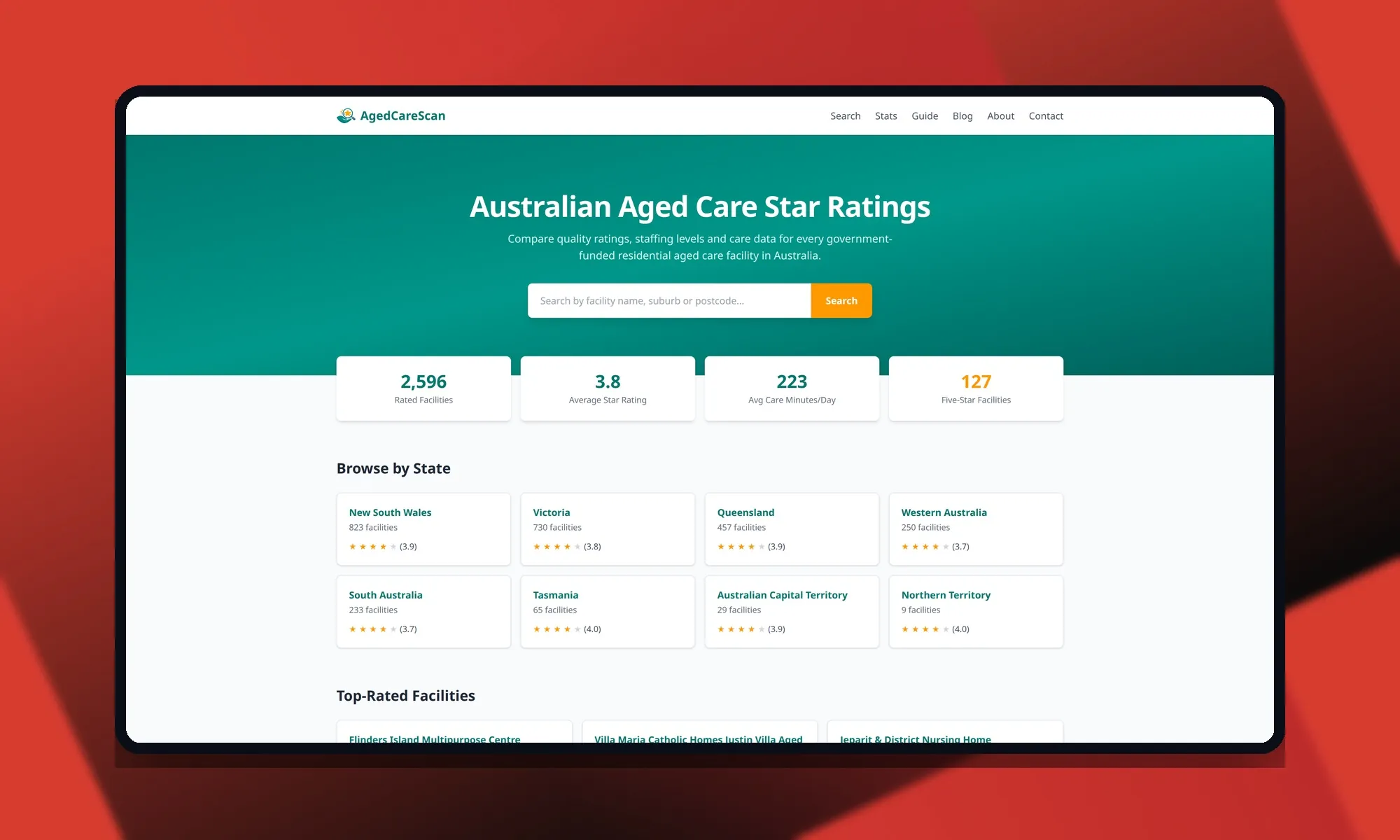
AgedCareScan is an own product from my network of sites that fills exactly that gap. I designed it, built it and operate it: it collects the ratings, quality indicators and staffing data for every aged care home subsidised by the Australian Government — 2,596 at the time of writing — and presents them as comparable profiles, state rankings and lists of the top-rated homes. It serves families looking for a place and sector professionals who need fast context.
There is no pay-to-appear model and no homes "featured" for advertising: the official ratings are what orders the listings. That neutrality is precisely what makes the product useful.
What it lets you do
- Facility search by name, suburb or postcode to find any home and open its quality profile.
- Browse by state and territory: all eight Australian jurisdictions with the facility count and average rating of each.
- Ranking of the top-rated homes, with the facilities that reach five stars and the provider behind each one.
- Breakdown of the four official sub-ratings: residents' experience, regulatory compliance, clinical quality measures and staffing.
- Staffing data expressed as care minutes and registered nurse minutes per resident per day, benchmarked against national standards.
- Guide and blog explaining how the Star Ratings system works, what rights residents have and what to look at before deciding.
How it's built
1. Laravel architecture
- Laravel and PHP backend on MySQL, with the data model organised around three entities: facility, provider and jurisdiction.
- Server-side rendering: every profile reaches the browser as complete HTML, with no JavaScript framework needed to paint the content. Good for the user and for the crawler.
- Lightweight frontend with Tailwind CSS and Alpine.js, compiled with Vite. No heavy libraries: interactivity is limited to what earns its keep.
2. Data pipeline
- Ingestion of the public records published by the Australian Government and normalisation into a custom schema: names, providers, locations and the four sub-ratings of each home.
- Automatic recalculation of averages, rankings and counters on every refresh: the homepage figures (2,596 facilities, 3.8-star average, 223 care minutes) always reflect the live dataset, never hand-written copy.
- Pre-computed state aggregations, so jurisdiction pages are served without expensive queries.
3. Programmatic SEO
- One indexable page per facility — 2,596 profiles with clean, stable URLs (
/facility/name-suburb-state) — plus state pages, top-rated listings and guide content. - Internal linking that follows the real structure of the data: from the homepage to the states, from each state to its facilities, from each facility to its provider and to comparable homes. The information architecture does the acquisition work.
- Template-driven metadata and structured data: titles, descriptions and markup generated from the data, not written one by one.
4. Performance
- Optimised queries to serve thousands of profiles with minimal load times, with indexes designed around real search patterns (by state, by rating, by provider).
- Versioned, preloaded assets, minimal CSS and JavaScript and no render-blocking third-party dependencies.
Coverage and data sources
Coverage spans the country's eight jurisdictions: New South Wales (823 facilities), Victoria (730), Queensland (457), Western Australia (250), South Australia (233), Tasmania (65), the Australian Capital Territory (29) and the Northern Territory (9). Each with its own average rating and complete facility listing.
All the information comes from public Australian Government records. The product's value is not in the data — which belongs to everyone — but in organising it, keeping it current and making it readable for someone facing a hard decision.
The result
A living comparison site that updates with every official data release and runs day to day with no manual intervention: the pipeline refreshes, the site recalculates and all 2,596 profiles stay correct. It belongs to my own network of sites and tools, alongside similar directories in Australia and the United States, and it doubles as a proving ground: what I learn operating these products — programmatic SEO, data pipelines, performance — is exactly what I apply to my clients' projects.
A few screenshots
Stack
Project website: Visit agedcarescan.com — own product, live in production.
Frequently asked questions about AgedCareScan
Where does AgedCareScan get its data?
From the official Star Ratings system the Australian Government publishes for every publicly funded residential aged care facility. AgedCareScan organises those records into comparable profiles: 2,596 rated facilities at the time of writing.
What exactly does the Star Ratings system measure?
Four areas: the residents' own experience (interviews about their day-to-day life), compliance with quality standards, clinical indicators such as falls, pressure injuries and medication management, and staffing levels measured in care minutes per resident per day.
Can I compare by state or territory?
Yes. The site groups facilities across the eight Australian jurisdictions with the average rating of each: from the 823 homes in New South Wales down to the 9 in the Northern Territory, via Victoria (730) and Queensland (457).
How many facilities hold five stars?
According to the site's own counters, 127 facilities hold the maximum five-star rating, against a national average of 3.8 stars and 223 care minutes per resident per day.
What technology is AgedCareScan built with?
Laravel and PHP on MySQL, rendered server-side, with a lightweight Tailwind CSS and Alpine.js frontend. Every facility, state and listing generates its own indexable page: traffic acquisition relies on programmatic SEO, not advertising.
More own products
More data platforms from the same portfolio.
Need something on this scale?
Laravel, data pipelines and programmatic SEO that works on its own. A 30-minute call, no strings attached.
Request a free quote