GuiaTraductorJurado
The official MAEC register of sworn translator-interpreters turned into a browsable directory: 8,391 professionals organised across 38 languages and 50 provinces, with verifiable profiles and pages per document type. My own product: I designed it, built it and run it.
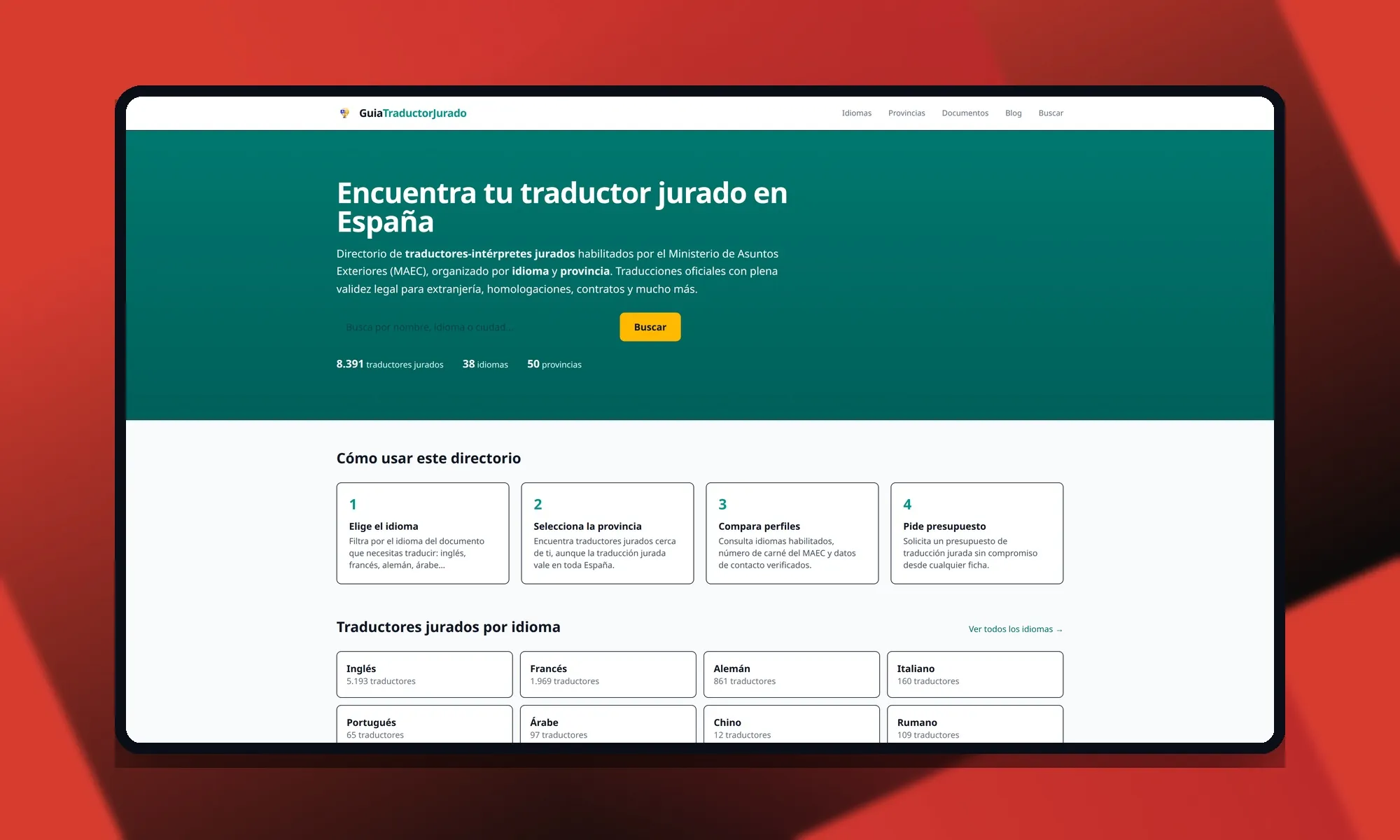
Why it exists: an official list nobody can actually use
An immigration file, a degree-recognition procedure or a cross-border contract all require a sworn translation — and finding the certified professional for the right language was surprisingly painful. The MAEC list exists and is public, but it was never designed for searching: it filters poorly, it can't be compared, and it doesn't answer the user's real question, which is almost never "give me the full list" but "I need a sworn Romanian translator near Alicante for a criminal-record certificate".
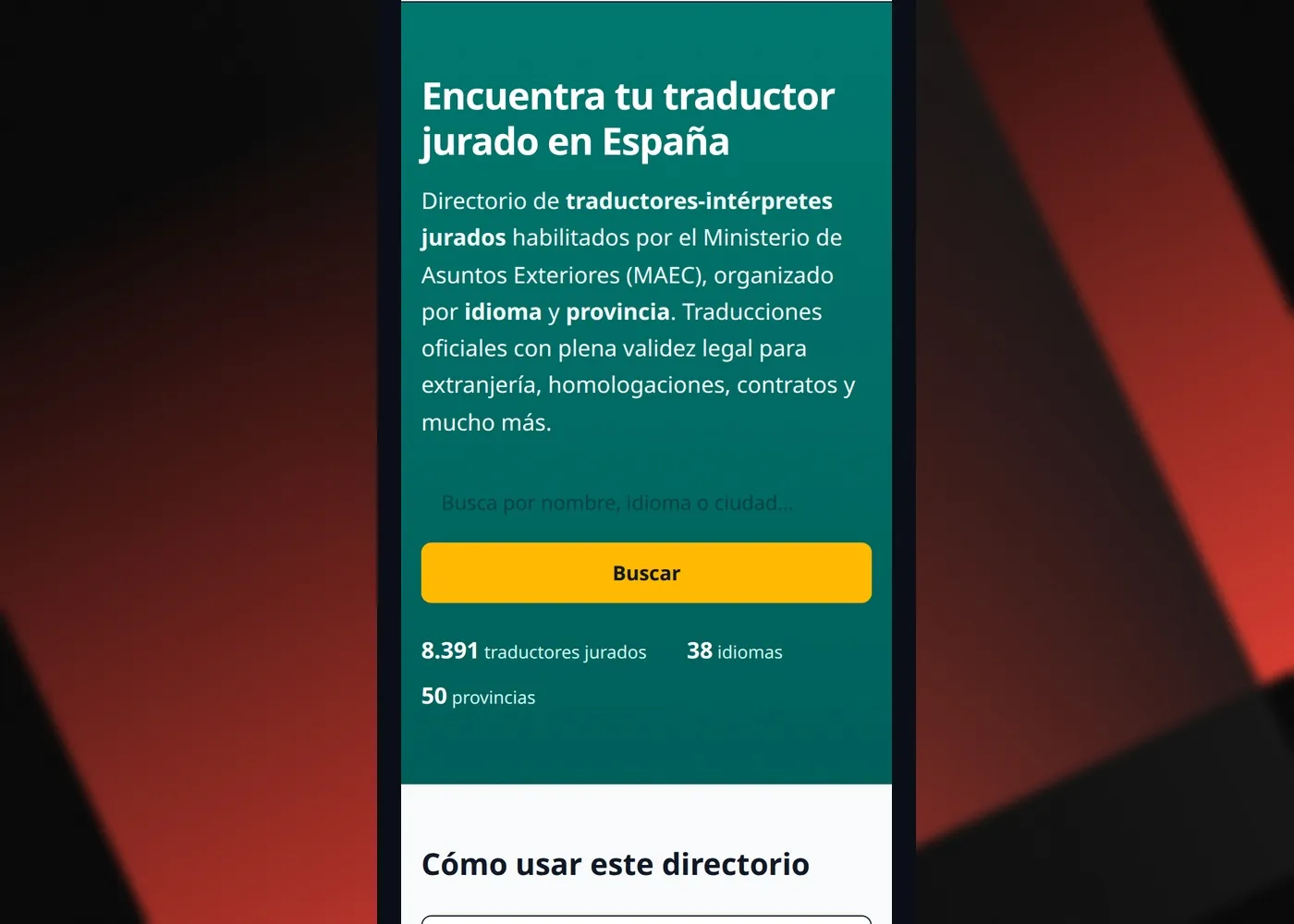
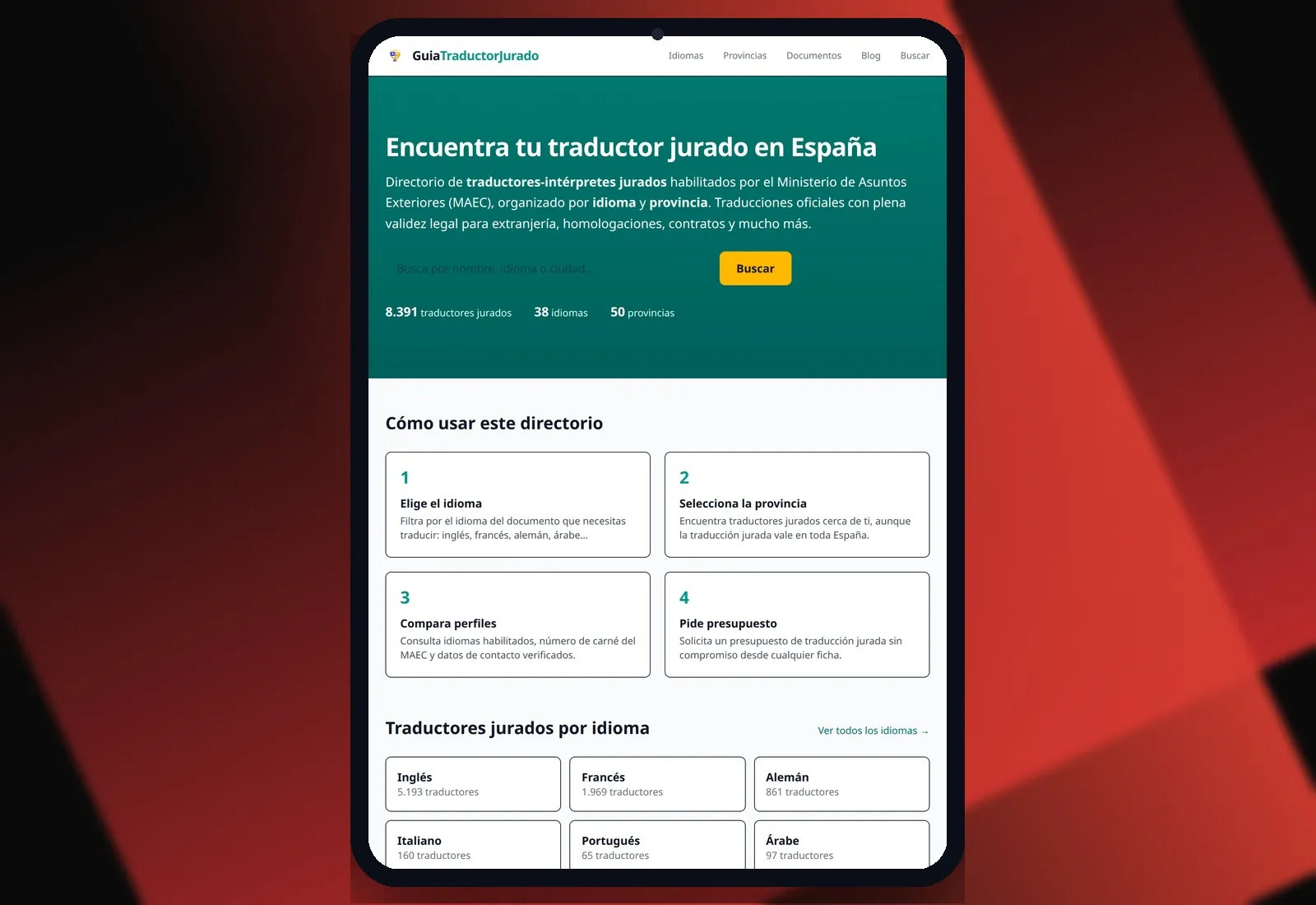
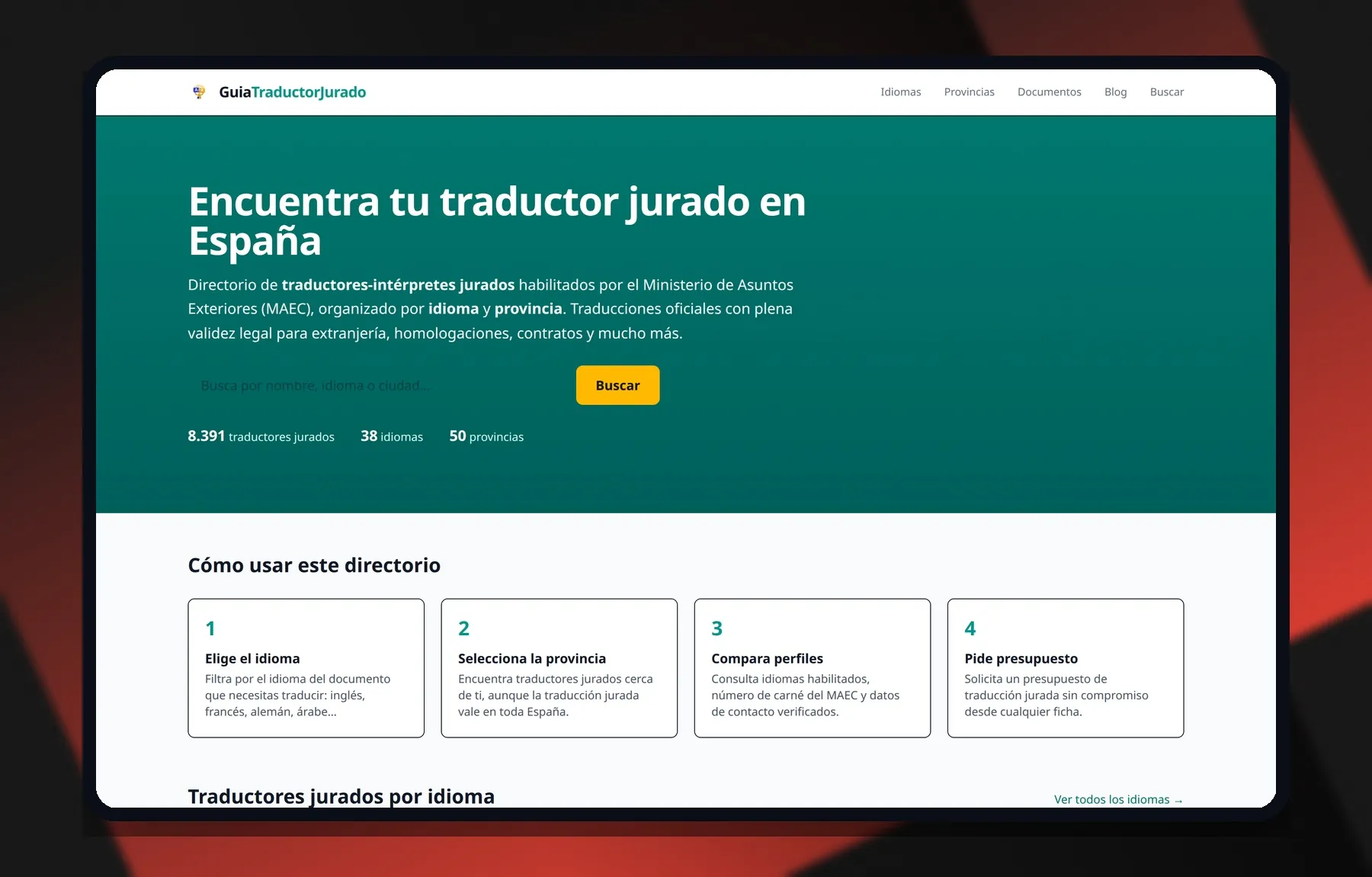
GuiaTraductorJurado.com solves exactly that: it turns the official list into a directory where the user crosses language × province × document type in a couple of clicks. The homepage guides visitors through a four-step flow — pick a language, select a province, compare profiles and request a no-obligation quote — and each step maps onto a real navigation layer of the site.
It is a product of my own network of sites, part of my family of Spanish professional guides alongside GuiaNotarial, GuiaGestoria and GuiaPeritoJudicial: directories that share the same philosophy and architecture, each built on a professional body with a verifiable data source.
What it lets you do
- Free-text search by name, language or city, plus structured browsing by language and by province.
- Complete profiles with certified languages, MAEC licence number, phone, town and star ratings with reviews.
- 38 browsable languages, from English (5,193 translators) down to Japanese, including Catalan, Galician and Basque.
- Pages per document type — academic degrees, birth and marriage certificates, criminal-record certificates, powers of attorney, court rulings — with market-rate guidance.
- Featured translators on the homepage with visible ratings and review counts.
- A specialised blog on the official procedures that require sworn translation.
How it's built
1. Laravel architecture
- Laravel + PHP backend on MySQL, with a data model that supports the directory's dual taxonomy: every translator belongs simultaneously to one or more languages and to a territory.
- Server-side templates for profiles, hubs and document pages, all fed from the same model — zero hand-duplicated content.
- Tailwind CSS compiled with Vite and Alpine.js for the little interactivity needed (menu, search box). No page builders, no generic themes.
2. Data pipeline
- Import of the official MAEC list with normalisation of names, provinces, phone numbers and certified languages before anything touches the database.
- Stable slugs per translator (name + province), so updates from the source can be re-imported without breaking URLs already indexed.
- The MAEC licence number visible on every profile, which is what lets the user verify the professional against the official source.
3. Programmatic SEO
- Thousands of pages generated from the data model: 8,391 translator profiles, language hubs, province hubs and document-type pages.
- Every language-province combination with enough volume becomes a landing page with its own search.
- Metadata and structured data (Schema.org) generated automatically, with canonical tags and the sitemap emitted from the same source.
- Computed interlinking between profiles, hubs and document pages so no page is left orphaned and authority flows towards the long tail.
4. Performance
- Server-rendered HTML and minimal JavaScript: the useful page arrives in the first response, without waiting for any client-side framework.
- Compiled CSS and preloaded assets, designed so a directory of thousands of pages crawls fast and loads fast at the same time.
Coverage and data source
The directory publishes 8,391 sworn translators across 38 languages and 50 provinces, always built from the official MAEC list. The distribution mirrors the country's real demand: English 5,193, French 1,969, German 861. By territory, Madrid leads with 2,226 professionals, followed by Alicante (945) and Barcelona (751).
The long tail is where the directory shines, with counts visible right on the homepage:
- Migration-driven languages: Romanian (109 translators), Arabic (97) and Russian (50).
- Co-official languages: Catalan (109), Galician (13) and Basque (11), a segment almost no competitor covers well.
- Scarce pairs such as Chinese (12) or Japanese (6), where ranking first is worth gold.
The result
An awkward official list became a directory where you find a sworn translator in minutes, with profiles verifiable against the source, honest market-rate guidance and one UX decision that defines the product: reminding users right in the interface that a sworn translation is valid throughout Spain, which frees them from an imagined geographic restriction and widens their contact options.
As my own product, it is also my best practical demonstration: the same data architecture, programmatic SEO and performance I build for clients, running in production on a real dataset of nearly 8,400 professionals.
A few screenshots
Stack
In production: Visit guiatraductorjurado.com
Frequently asked questions
What exactly is a sworn translator?
A translator-interpreter certified by Spain's Ministry of Foreign Affairs (MAEC) whose translations carry full legal validity in Spain: they are required for immigration files, degree recognition, contracts, certificates and court documents.
How many professionals and languages does the directory cover?
The homepage lists 8,391 sworn translators, 38 languages and 50 provinces. English concentrates 5,193 professionals, followed by French with 1,969 and German with 861.
Is the listing based on an official source?
Yes: the site describes itself as a directory built on the official MAEC list, and each translator profile displays the licence number alongside the certified languages and contact details.
Do I have to pick a translator from my own province?
No. As the site itself points out, a sworn translation is valid throughout Spain; the province filter exists for convenience, not as a legal requirement.
Does the site explain which documents need a sworn translation?
Yes. There are dedicated pages per document type — academic degrees, birth and marriage certificates, criminal-record certificates, powers of attorney, court rulings — with market-rate guidance, plus a blog focused on official procedures.
More products of my own
More professional guides from my network of sites built on Spanish public data.
Got data that could become a product?
I design, build and run data platforms with programmatic SEO, like this one. Free 30-minute call, no strings attached.
Request a free quote