GuiaNotarial
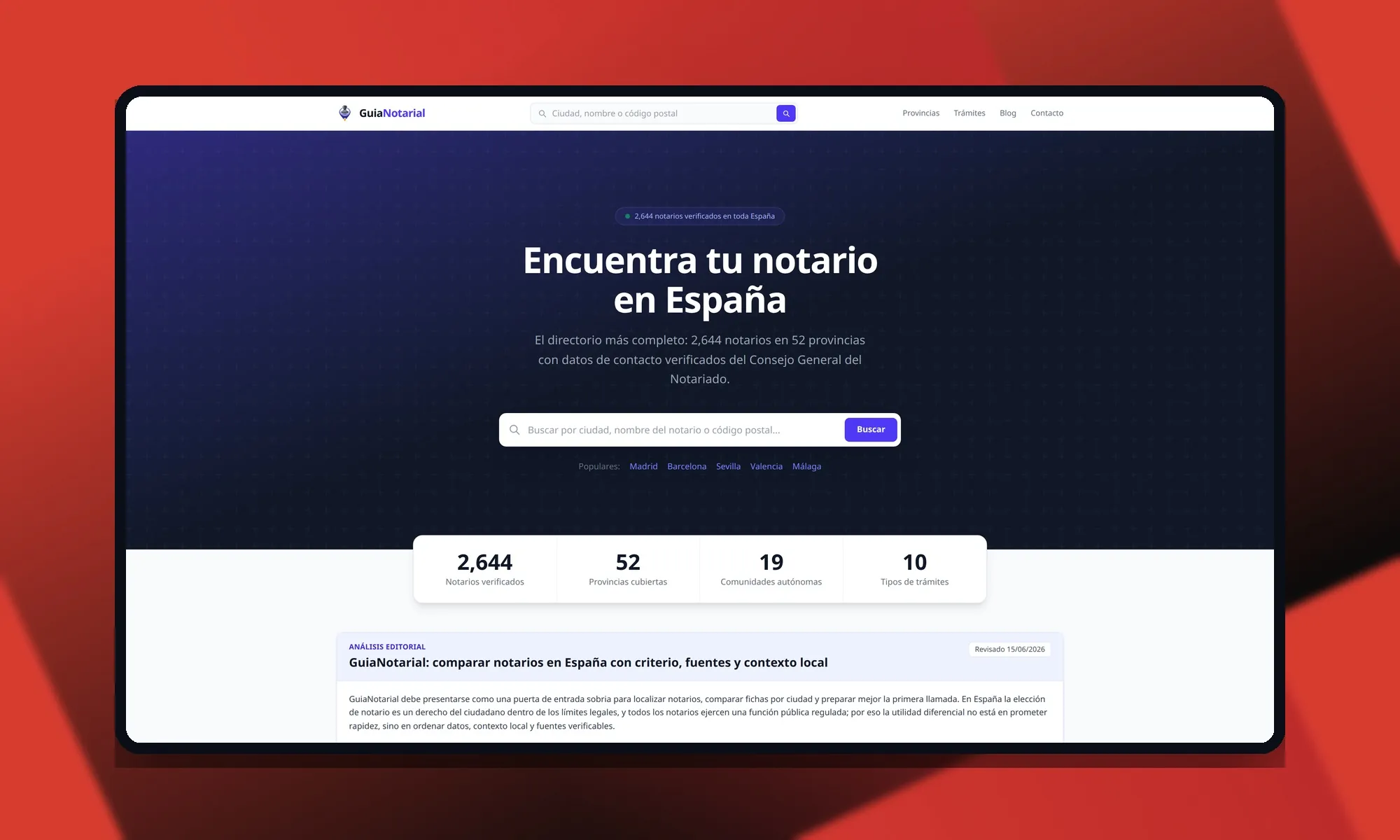
Spain's directory of notarial offices: 2,644 verified notaries across 52 provinces, searchable by city, name or postcode, with procedure guides and editorial analysis backed by official sources. Designed, built and operated by me with Laravel, MySQL and programmatic SEO.
Why GuiaNotarial exists
Almost everyone deals with a notary at some point — buying a home, settling an inheritance, granting powers of attorney, incorporating a company — and almost nobody knows how to choose one. In Spain, the free choice of notary is a right recognised by the Notarial Regulation, but the information needed to exercise it was scattered: incomplete listings, unverified profiles and no site explaining the procedures in plain language.
GuiaNotarial.com brings order to that chaos: a profile for every notarial office, listings by city, province and autonomous community, guides to the most common procedures, and a layer of editorial analysis with cited sources — the Notarial Regulation in the BOE, the Ministry of Justice, the Portal Notarial and the General Council of Spanish Notaries. That respect for the notarial public function, with no opaque rankings and no promises, is a deliberate product decision: every notary performs a regulated role, and the portal doesn't try to score them — it helps you reach the first phone call with the right paperwork.
It isn't a client engagement: it's an own product from my network of websites, a sibling of other Spanish professional guides I've built with the same philosophy, such as GuiaTraductorJurado, GuiaGestoria and GuiaPeritoJudicial. I designed the data model, wrote the platform and run the SEO and the day-to-day operations.
What it lets you do
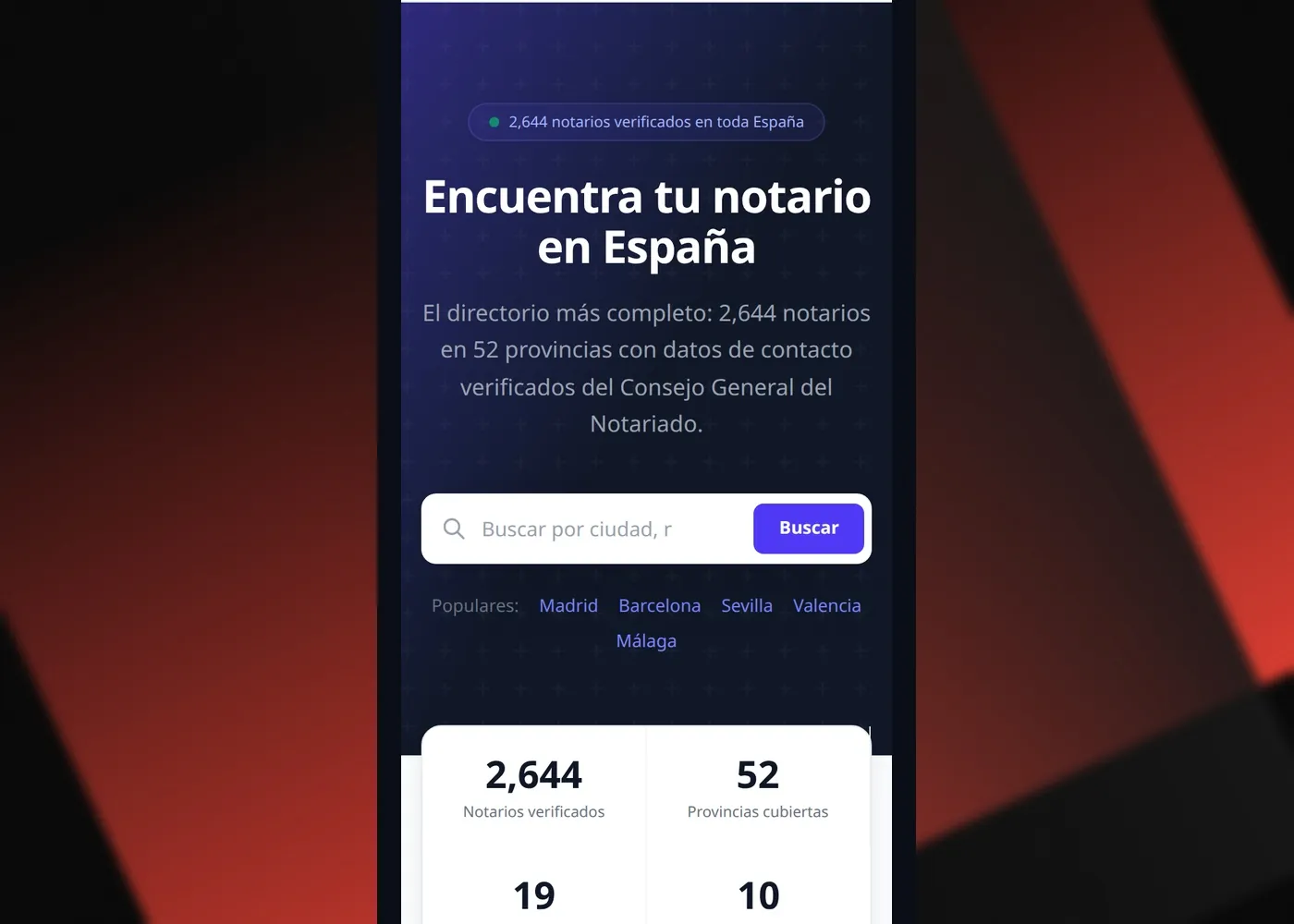
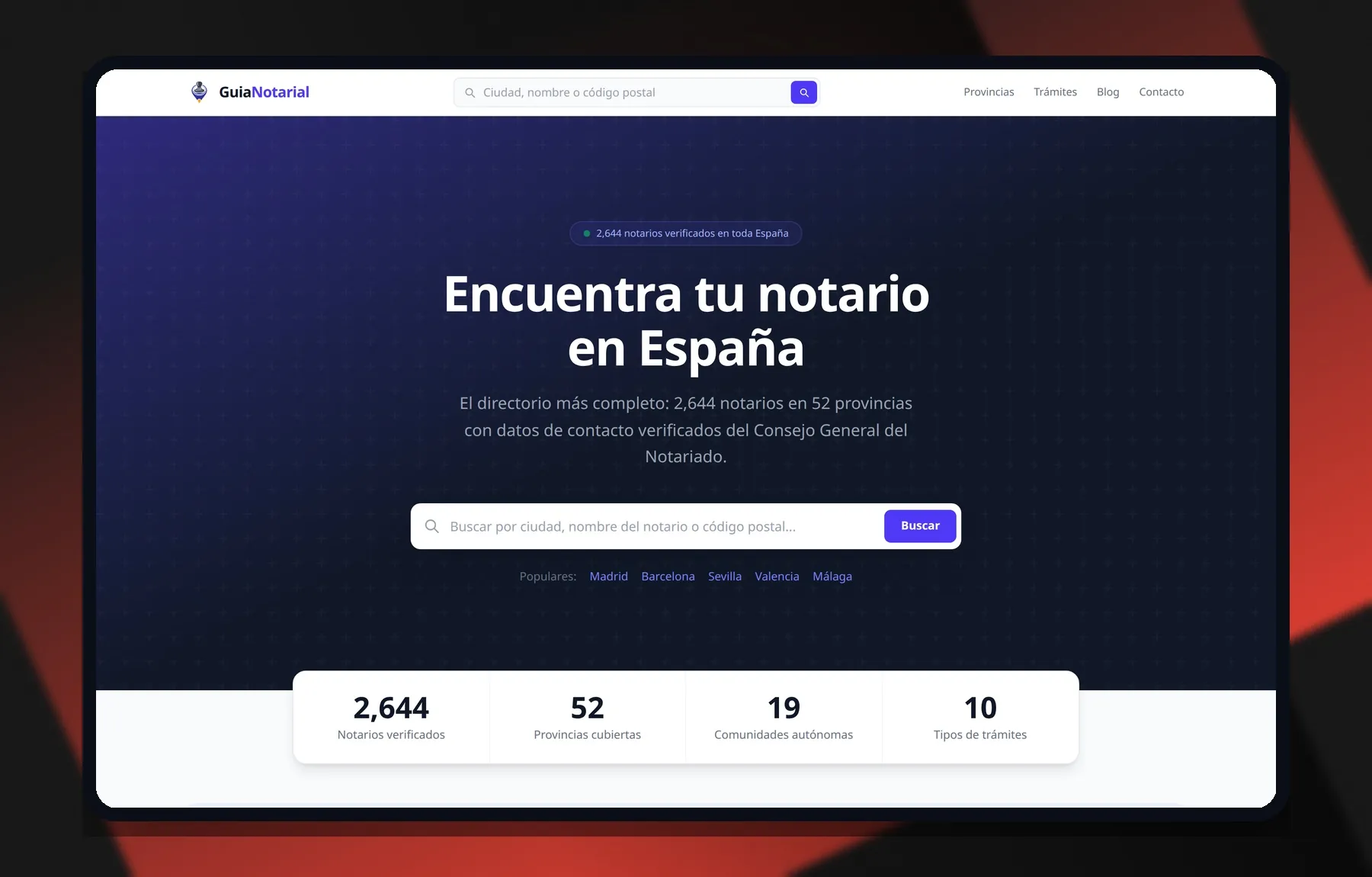
- Instant search by city, notary name or postcode, embedded even in the navigation bar and on the homepage.
- Notarial office profiles with address, phone number, notarial college and freshness signals that separate official data from entries pending review.
- Territorial listings by autonomous community and province with real counts (467 in Andalusia, 439 in Catalonia, 327 in the Madrid region, 321 in the Valencian Community…).
- Notarial procedure guides: 10 types of paperwork covered, from powers of attorney to property sales.
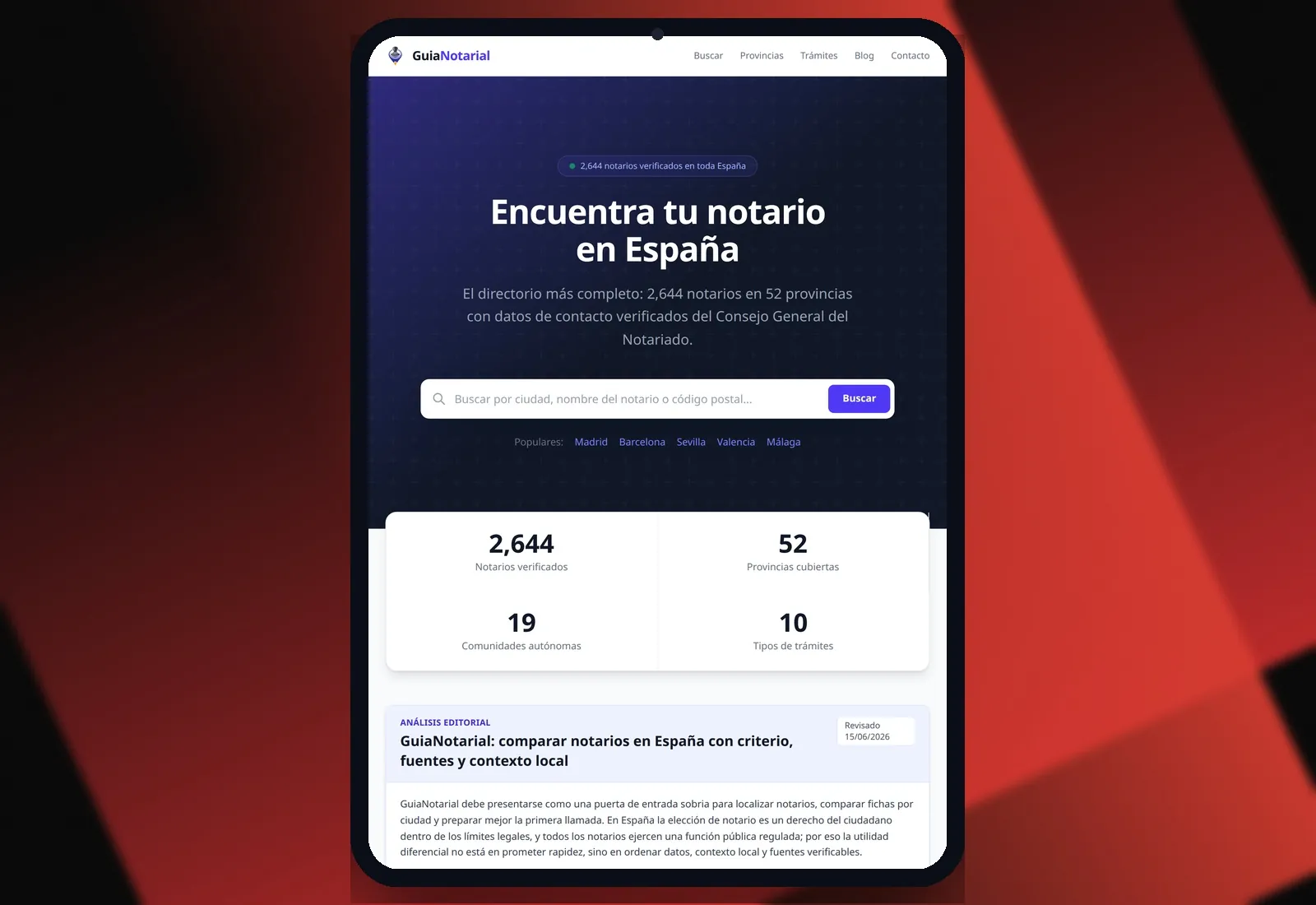
- Reviewed editorial analysis with a visible revision date and a bibliography of linked official sources.
- Blog and contact section completing the organic acquisition loop.
How it's built
1. Laravel architecture
- Laravel backend on MySQL: Eloquent models for notaries, towns, provinces, communities and procedures, with the relationships that later feed every template.
- Server-rendered HTML with Blade templates and assets compiled with Vite: every URL leaves the server ready to read, without waiting for any JavaScript.
- Tailwind CSS and Alpine.js on the interface layer: lightweight components (search box, mobile menu) with no heavy frontend frameworks.
2. Data pipeline
- Verifiable origin: the corpus starts from the public information of the General Council of Spanish Notaries, not from indiscriminate scraping.
- Territorial normalisation: every notary is linked to their town, province and autonomous community, and the counts you see on the site (2,644 in total) are computed from the database, not by hand.
- Freshness signals on the profiles to distinguish confirmed official data from information pending review — honesty about the data is part of the product.
3. Programmatic SEO
- Every territorial combination generates unique listing pages with clear search intent ("notario en Málaga", "notarios en Galicia"): a single dataset becomes hundreds of indexable URLs.
- Per-page metadata: dedicated title, description and canonical, Open Graph and JSON-LD structured data (Organization and WebSite with SearchAction, visible in the page source).
- Internal-linking architecture that channels authority from the homepage down to communities, provinces and profiles, with shortcuts to the most popular searches (Madrid, Barcelona, Seville, Valencia, Málaga).
4. Performance
- Zero heavy hydration: the HTML arrives rendered and Alpine.js only wakes up for the occasional interaction.
- Compiled, versioned CSS and JS with Vite, preloaded from the document head for a fast first paint.
- Clean crawling for search engines: no prefab themes, no third-party plugins, and measurement via Google Analytics 4.
Coverage and data provenance
The current corpus published on the homepage: 2,644 notaries across 52 provinces and 19 autonomous communities, with 10 documented procedure types. The listings show real counts per territory — from Andalusia's 467 notaries to Extremadura's 68 — and the editorial section leans on linked official sources: the Notarial Regulation in the BOE, the Ministry of Justice, the Portal Notarial and the General Council of Spanish Notaries. You can verify all of it on the live site.
The outcome
GuiaNotarial is today a national directory in production that I operate as my own product: the complete dataset of the Spanish notariat organised by territory, a search box that answers instantly, and a dated, referenced editorial layer that gives it credibility over flat phone listings. Acquisition is 100% organic — the programmatic SEO does the commercial work.
As a case study it proves something very concrete: the same Laravel + MySQL + programmatic SEO machinery I apply to client projects, running in a product where the only person responsible for making it rank, load fast and stay reliable is me.
A few screenshots
Stack
Project website: Visit guianotarial.com — an own product from my network of websites.
Common questions
How many notaries does GuiaNotarial.com list?
The homepage shows 2,644 verified notaries across all 52 provinces and 19 autonomous communities: Andalusia leads with 467, followed by Catalonia with 439 and the Madrid region with 327.
Where does the contact data come from?
The site states that contact details are verified against the public information of the General Council of Spanish Notaries (Consejo General del Notariado), and its editorial section also cites official sources such as the Notarial Regulation (BOE), the Ministry of Justice and the Portal Notarial.
Can I freely choose my notary in Spain?
Yes. As the portal itself points out, citing the Notarial Regulation, the free choice of notary is a citizen's right within legal limits. The directory exists precisely so you can compare notarial offices before deciding.
What technology is GuiaNotarial built with?
A Laravel backend on MySQL, with server-rendered HTML, Tailwind CSS and Alpine.js on the interface layer, and JSON-LD structured data (Organization and WebSite with SearchAction) visible in the homepage source code.
Who is behind GuiaNotarial?
It is an own product of Adrian Rojas Barrera, freelance developer: he designed the data model, built the platform in Laravel and runs the SEO. It is not a client engagement.
Want a data platform that ranks on its own?
Laravel, programmatic SEO and data models that turn into hundreds of useful pages. A free 30-minute call, no strings attached.
Request a free quote