RecallDex
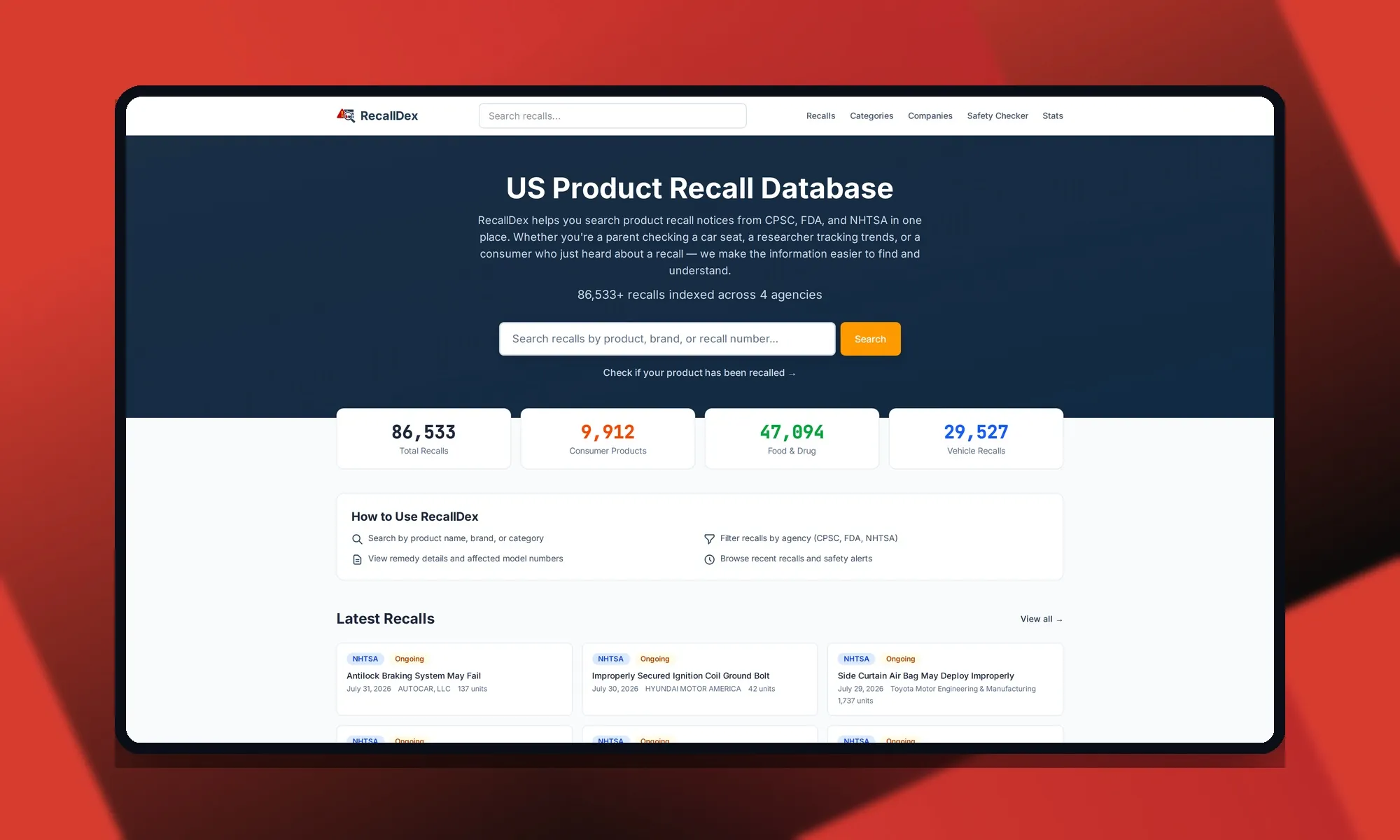
Over 86,500 official recalls of toys, food, drugs and vehicles in the US, gathered into a single search engine with a safety checker. An own product from my network of sites: concept, development, data pipeline and SEO, all home-grown.
Why it exists: four agencies, zero big picture
In the United States, product recalls aren't published in one place. The CPSC announces consumer product recalls, the FDA handles food on one side and drugs on the other, and the NHTSA covers vehicles. Four databases with different formats, different search tools and different criteria. Anyone wanting to know whether their child car seat, their medication or their van is affected first has to know which agency to ask — and most people don't.
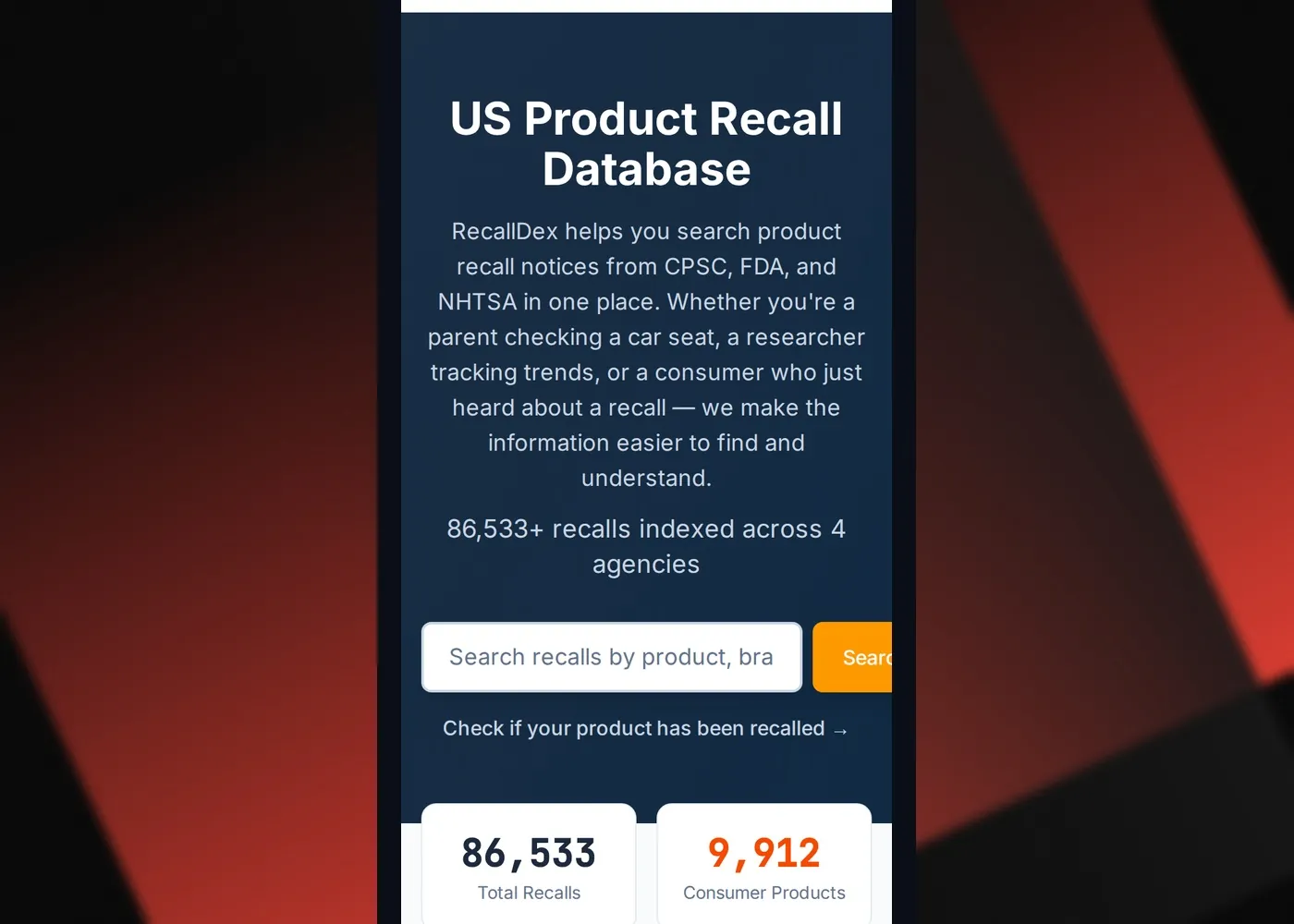
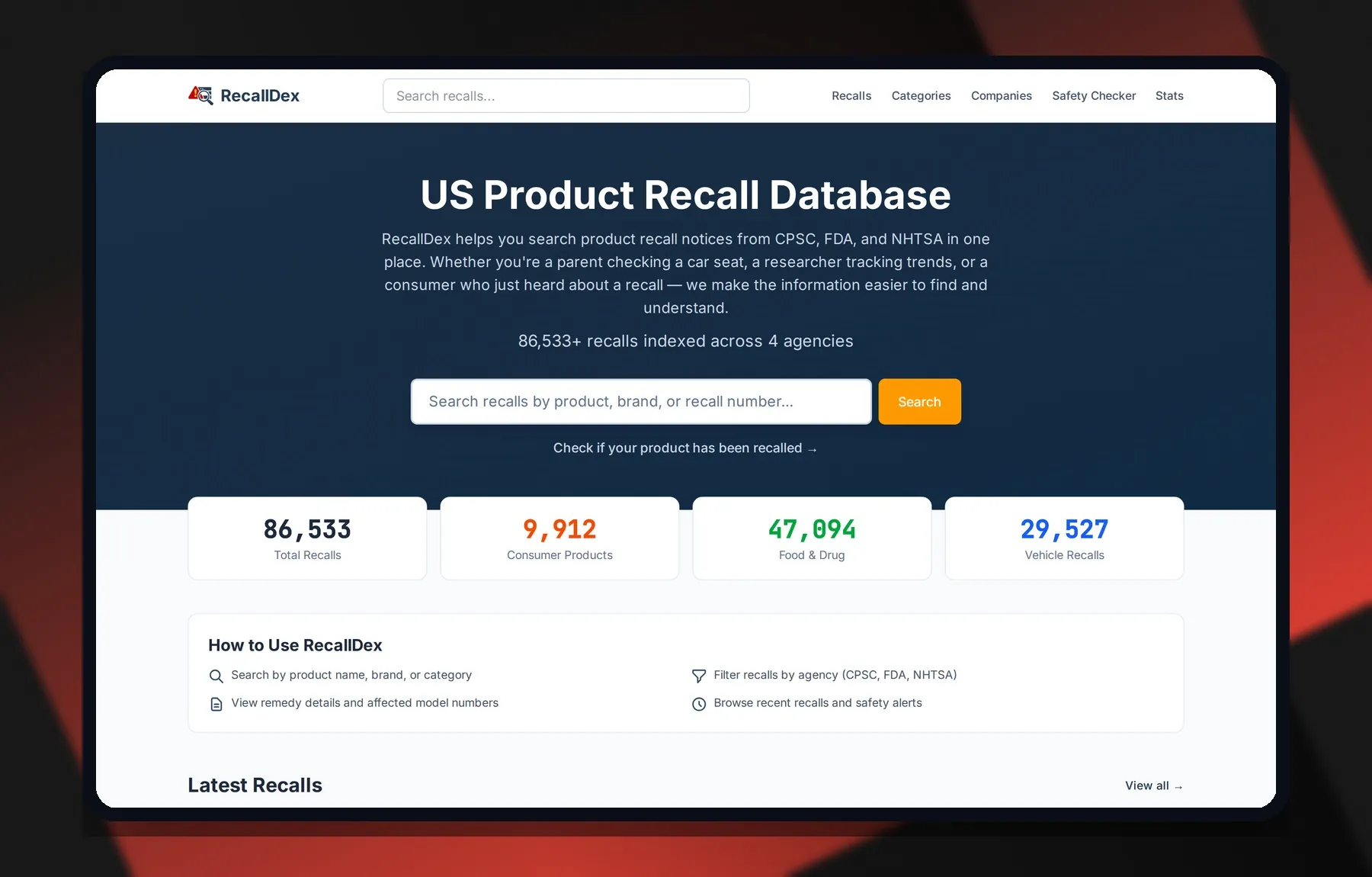
RecallDex exists to remove that problem: it aggregates notices from the four official sources, normalizes them into a single schema and makes them searchable from one search box. Today it indexes 86,533 recalls and keeps growing with every new notice.
It's an own product from my network of public-data sites: I designed it, built it and run it myself, end to end.
What it lets you do
- Search recalls by product name, brand or recall number.
- Filter by agency: CPSC, FDA (food), FDA (drugs) or NHTSA.
- Safety Checker: find out in seconds whether a specific product has been recalled.
- See the remedy and affected models for every recall, with the units involved and the manufacturer.
- Browse by category (vehicles, food, drugs, cribs, toys, bicycles…), each with its real case counter.
- Check the company directory ranked by total number of recalls.
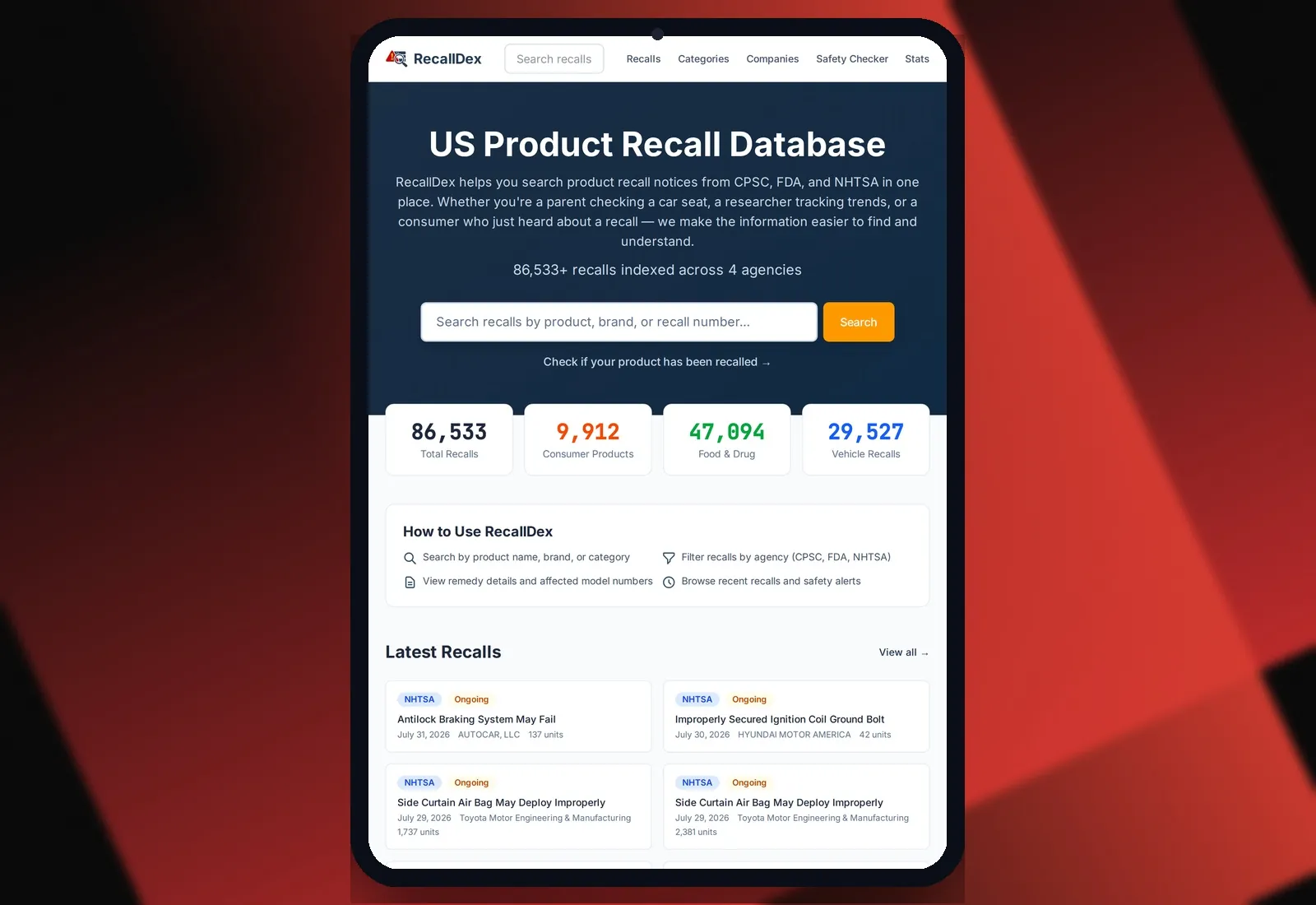
- Follow the latest published alerts, with their date, company, affected units and status (ongoing or completed).
How it's built
1. Laravel architecture
- Laravel + PHP on the backend with Alpine.js as a lightweight interactivity layer — no SPA, no dead weight.
- Normalized MySQL: recalls, categories, companies and sources in related tables, so every entity resolves to a URL of its own.
- Semantic routes: every recall lives at a readable slug that includes the official case number, and every category and company has its own browsable hub.
2. Data pipeline
- ETL against four official sources with clashing formats, unified into one coherent schema.
- Normalization of manufacturers, categories, case statuses and affected units so everything is filterable and comparable.
- Regular ingestion of new notices: the homepage shows recalls published the same week, with their status up to date.
3. Programmatic SEO
- Tens of thousands of indexable pages, each with its own title, meta description and structured data generated from the database.
- Agency, category and company hubs that spread internal authority towards the recall pages and capture long-tail searches.
- Custom development, no templates or plugins: the HTML leaves the server ready to index.
4. Performance
- Server-side rendering: content arrives complete in the first response, with no waiting for JavaScript.
- Indexed queries and pagination to serve catalogues of tens of thousands of records without slowing down.
- Assets compiled and versioned with Vite, with critical CSS and JS preloaded.
Coverage and data sources
The data comes exclusively from official US public records: the CPSC contributes 9,912 consumer product recalls, the FDA adds 29,263 for food and 17,831 for drugs, and the NHTSA brings 29,527 vehicle recalls.
Case sizes vary enormously: among the latest alerts, campaigns of a handful of units sit next to massive ones, such as a Mercedes-Benz rollaway-risk recall affecting more than 310,000 vehicles. In the company ranking, Ford tops the list with 1,691 cases, followed by General Motors with 1,183.
The outcome
RecallDex works both as a real service for consumers and as a public demonstration of what I can build: serious ETL over four sources with incompatible formats, a checker that answers in seconds against more than 86,000 recalls, and a surface of tens of thousands of indexable pages that grows on its own with every new agency notice.
It's exactly the same pattern I apply to client projects: aggregating, normalizing and publishing data from any sector on fast platforms that rank on their own.
A few screenshots
Stack
The product, live: Visit recalldex.com
Frequently asked questions
Which agencies feed RecallDex?
Four official US sources: the CPSC (consumer products), the FDA through its food and drug divisions, and the NHTSA (vehicles).
How many recalls are on record?
86,500+ in total: around 9,900 consumer product recalls (CPSC), 47,000 food and drug recalls (FDA) and 29,500 vehicle recalls (NHTSA). The number grows with every new notice the agencies publish.
How do I know whether something I own is affected?
Run it through the Safety Checker to see whether it has been recalled; each recall page also details the remedy offered and the affected model numbers.
Is the database kept up to date?
Yes. New agency notices are added on a regular basis: the homepage lists the latest published recalls with their date, the company responsible, the units affected and the case status (ongoing or completed).
Which companies have the most recalls?
The company directory ranks them by number of cases: Ford tops the list with 1,600+ recalls, followed by General Motors with 1,100+.
Who is the platform useful for?
Parents checking a child car seat, researchers tracking safety trends, and any consumer who has just heard about a recall.
More own products
Need a data platform on this scale?
Laravel, public-source ETL and programmatic SEO at scale. A free 30-minute call, no strings attached.
Request a free quote