ZipCodeDex
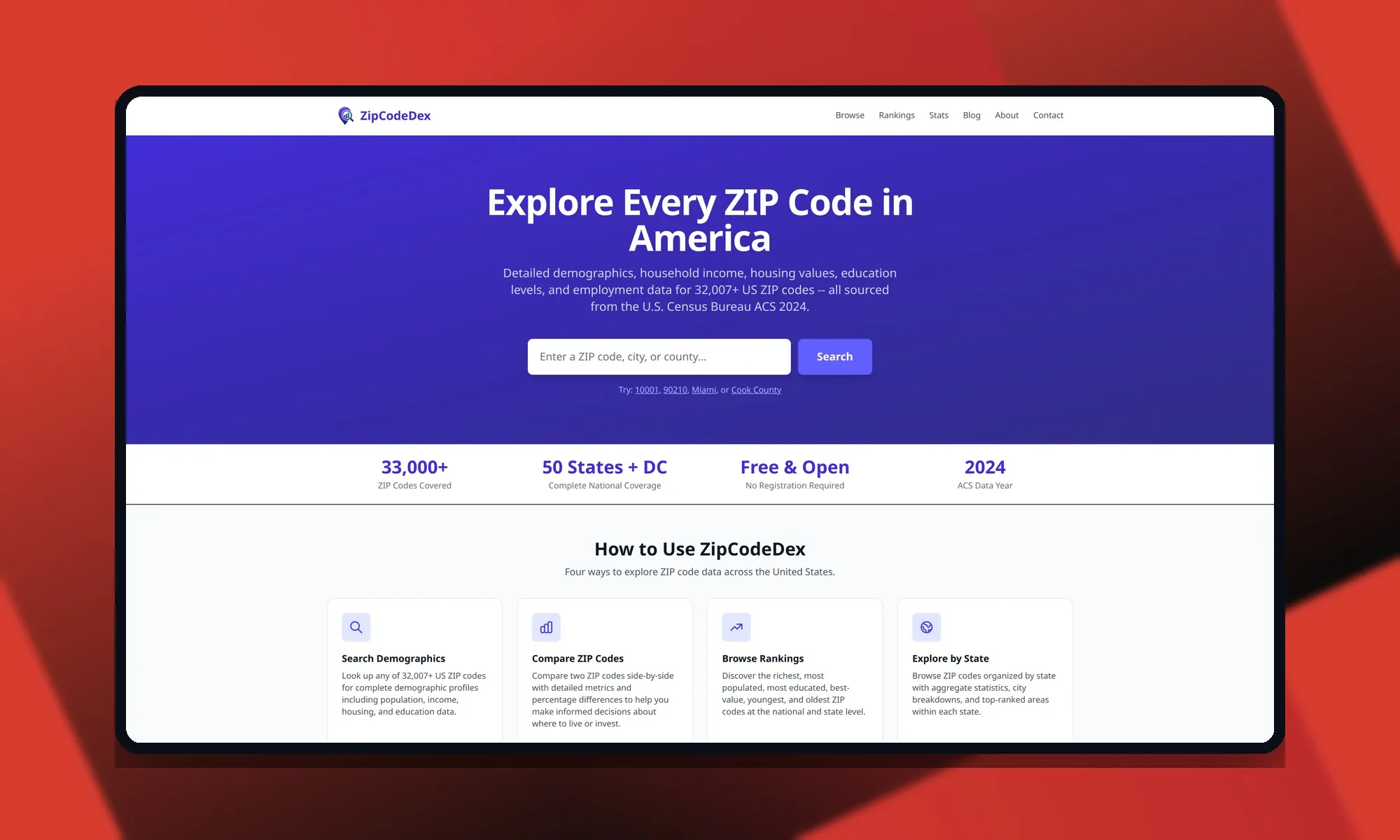
A demographic directory of 33,000+ US ZIP codes: population, household income, home values, education and employment with official Census ACS 2024 data. An own product from my network of sites, built with Laravel, MySQL and programmatic SEO.
Why it exists: a public dataset almost nobody can read
Every year the US Census Bureau publishes the American Community Survey: thousands of tables, an API and raw files holding the country's demographic X-ray. The information exists and it's public, but it isn't readable — anyone who wants to know what 10001 in New York or 90210 in Beverly Hills is really like before moving or investing runs into spreadsheets, not answers.
ZipCodeDex is my answer to that gap: an own product from my network of sites and tools that turns that dataset into the full profile of every ZIP code in the country — free, with no registration, straight from the official source. I designed it, built it and run it myself, from the first data migration to the latest deploy.
It's used by people weighing up where to live, real-estate investors comparing areas, and marketing or expansion teams that need to understand an area's income and make-up before betting on it. And for me it serves a second purpose: it's the lab where I push programmatic SEO at scale before applying it to client projects.
What it lets you do
- Full demographic profile. Population, household income, home value, education level and employment for every ZIP — 10001 in New York, for instance: 30,511 residents and a $129,852 median income.
- Two-ZIP compare tool. Side-by-side metrics with percentage differences, so choosing between two areas rests on data rather than gut feel.
- National and state rankings. Six leaderboards: the richest, most populated, most educated, best-value, youngest and oldest ZIPs.
- State pages. Aggregate statistics, city breakdowns and the top-ranked areas for each of the 50 states and DC.
- Flexible search. By ZIP code, city or county — “10001”, “Miami” or “Cook County” all work equally well.
- Open access. No accounts, no paywalls: open data presented clearly.
How it's built
1. Laravel architecture
- Laravel + PHP on MySQL. Every page type — ZIP profile, state, ranking, compare view, search — is its own Blade view, designed around the search intent it serves. No generic templates.
- Clean, predictable routes (
/zip/10001,/state/california,/richest) that make every URL an indexable entity with meaning of its own. - Lightweight frontend: Tailwind CSS and Alpine.js compiled with Vite. No SPA, no heavy client frameworks — server-rendered HTML, the way a content site should be.
2. Data pipeline
- Batch imports of the Census Bureau's ACS tables, normalised into a custom MySQL schema keyed by ZIP code.
- Pre-computed aggregates per state and city at import time, so no request ever has to run an expensive calculation on the fly.
- Rankings derived from the dataset itself: when the census releases a new ACS edition, the pipeline reruns and the 33,000+ profiles, states and leaderboards update in one pass.
3. Programmatic SEO
- Tens of thousands of unique URLs with titles, meta descriptions and structured data generated from each ZIP's real data — no cloned filler text.
- Hierarchical interlinking state → city → ZIP, plus featured-code blocks that spread crawl budget and internal authority.
- XML sitemaps and canonicals so search engines index the whole catalogue without duplicates, plus an own blog feeding the editorial side.
4. Performance
- Simple, indexed reads: with aggregates pre-computed, every profile is served with trivial MySQL queries.
- Optimised assets: preloaded CSS, minimal modular JavaScript and stable HTML that causes no layout shifts.
- Cloudflare in front as CDN and anti-bot protection layer to absorb the crawl traffic a site this size generates.
Coverage and where the data comes from
All the information comes from the American Community Survey 2024, the US Census Bureau's official demographic study. Coverage is national: 33,000+ ZIP codes spread across the 50 states and the District of Columbia, each with its own breakdown page — 1,678 codes in California, 1,491 in Florida, 1,348 in Illinois, 850 in Alabama…
The featured profiles hint at the level of detail: Beverly Hills' 90210 lists 19,004 residents and a $187,801 median income; Chicago's 60601, 15,235 residents and $121,458. Official figures, presented so anyone can understand them at a glance.
The result
ZipCodeDex is in production, open and free: a public dataset almost nobody could read, turned into tens of thousands of unique, indexable pages that answer specific searches — “10001 demographics”, “median income in Beverly Hills”, “richest ZIP codes in Florida” — without me writing a single one of them by hand.
And it serves its other purpose too: when a client asks me whether programmatic SEO really works, I don't show them a slide. I show them this — architecture, data pipeline, indexation and performance operating together in a real product I maintain myself.
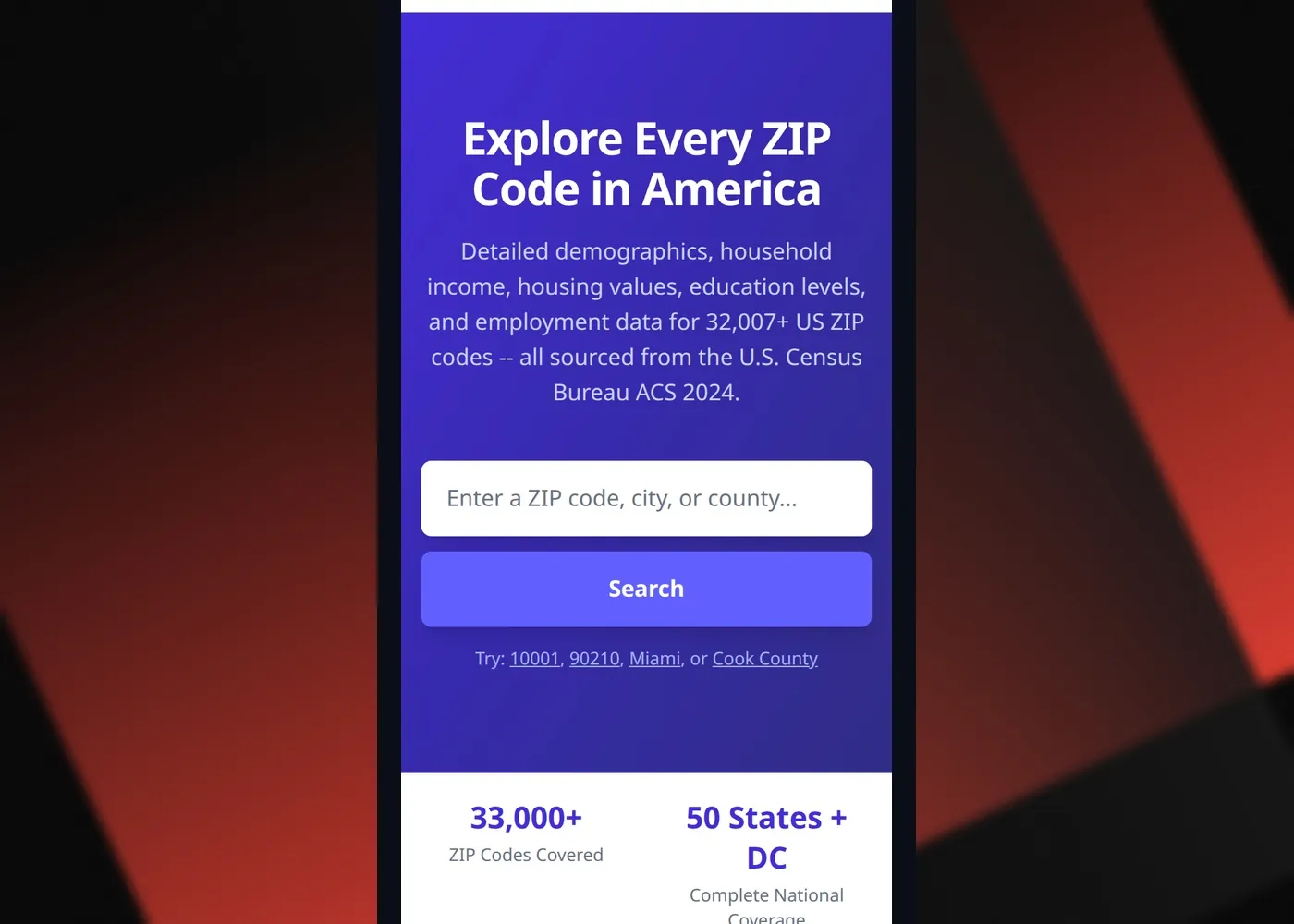
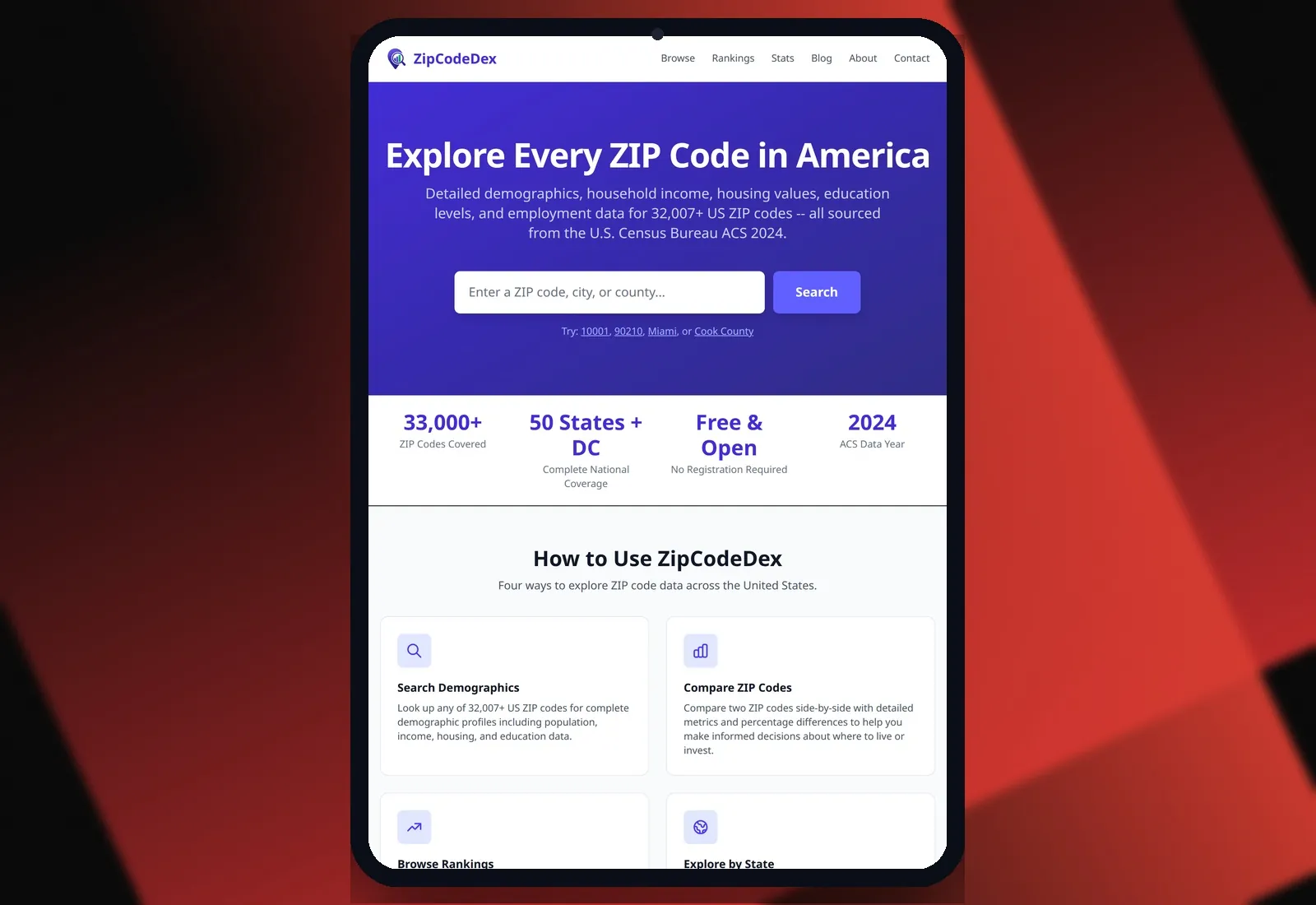
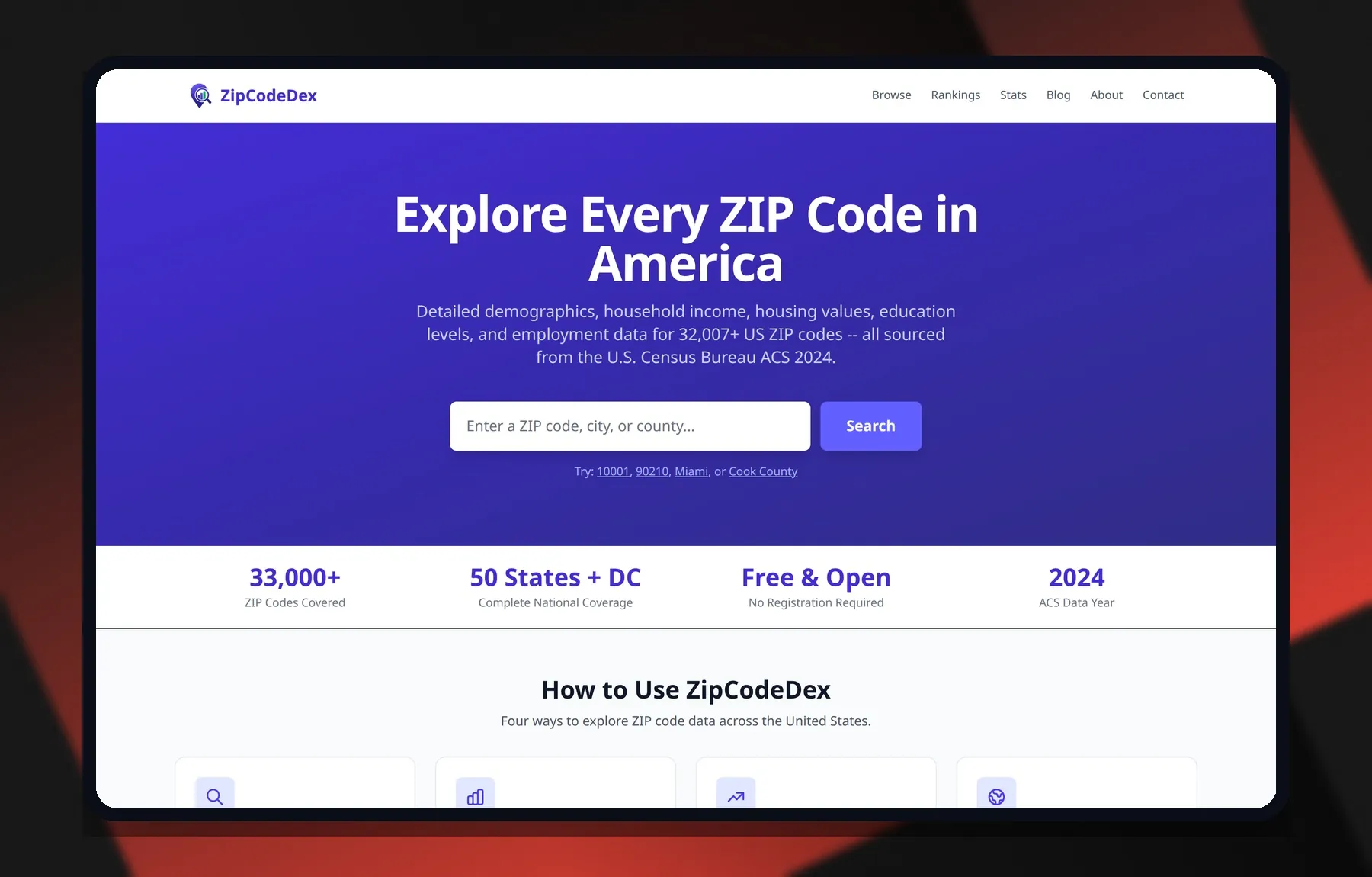
A few screenshots
Stack
Live product: Visit zipcodedex.com — open, no registration.
ZipCodeDex questions answered
What data source does ZipCodeDex use?
The American Community Survey (ACS) 2024 from the US Census Bureau, the country's official demographic study. All the population, income, housing, education and employment information comes from there.
How many ZIP codes does it cover?
Over 33,000 ZIP codes across the 50 states and the District of Columbia, with complete national coverage. Each state has its own breakdown page: 1,678 codes in California, 1,491 in Florida, 850 in Alabama…
Is it paid, or does it require registration?
Neither. ZipCodeDex is free, open and registration-free. Search a ZIP, a city or a county and you see its full profile instantly.
What kind of rankings does it include?
The richest, most populated, most educated, best-value, youngest and oldest ZIP codes, both nationally and within each state.
Can two ZIP codes be compared side by side?
Yes. The compare tool shows two ZIPs side by side with their metrics and the percentage differences between them — population, household income, home value, education and employment — so you decide with data, not gut feel.
More own products
Sister directories for exploring housing, education and local life in the US.
Got data that could become a product?
Laravel, programmatic SEO and data pipelines that turn a dataset into thousands of pages that rank. Free 30-minute call, no strings attached.
Request a free quote