TowerDex
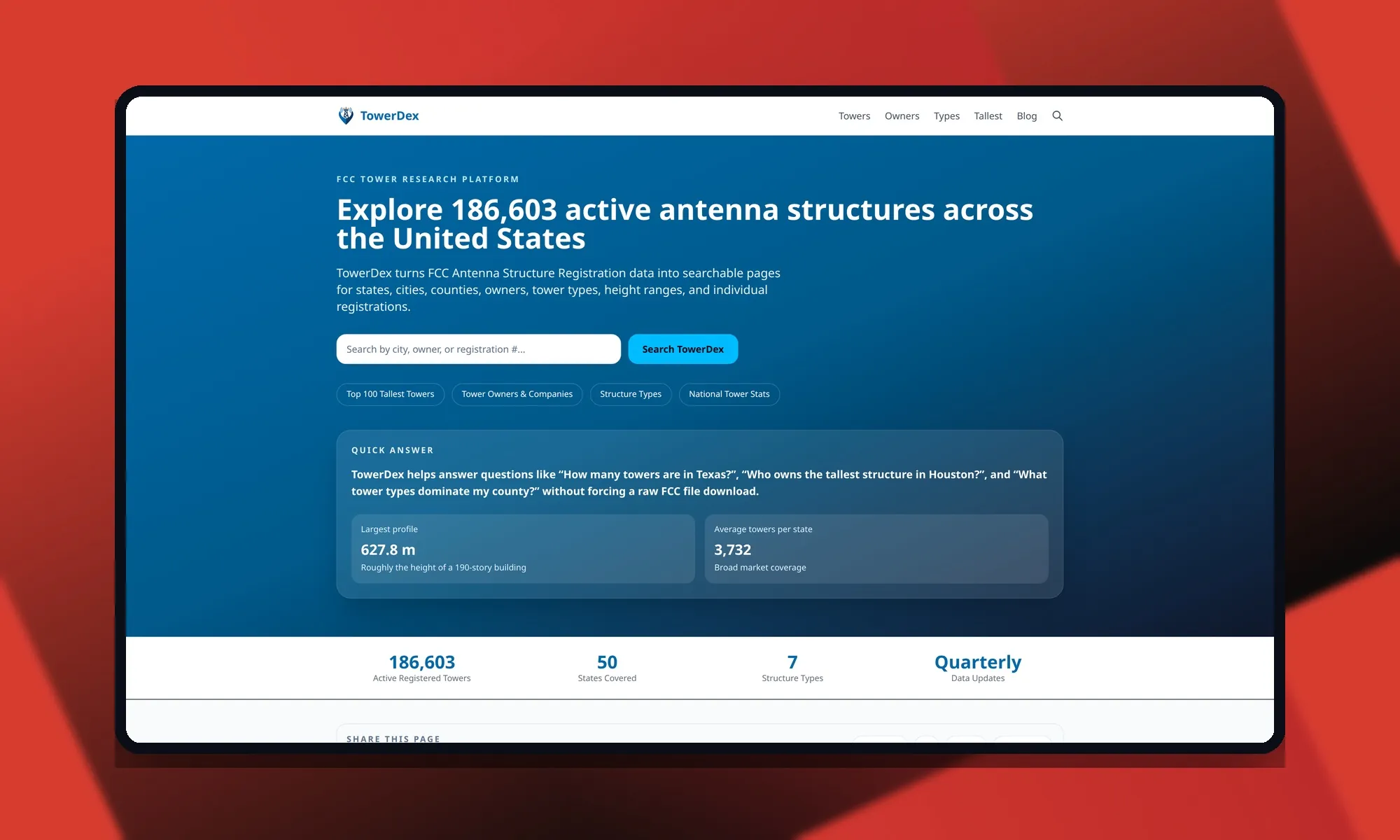
186,603 active antenna structures from the US federal ASR registry, reshaped into a search engine you can browse by state, city, county, owner, structure type and height. An own product: I designed it, built it and run it.
The problem: a public registry nobody can actually read
The FCC — the US telecommunications regulator — requires antenna structures above a certain height, or close to an airport, to be filed in the Antenna Structure Registration (ASR). It is a public registry: anyone can access it. The problem is how.
Querying the ASR means wrestling with raw file downloads, coded columns and fields that only make sense if you already speak the regulator's nomenclature. If what you want to know is "How many towers are there in Texas?", "Who owns the tallest structure in Houston?" or "What tower types dominate my county?", the data exists but it is buried. A site acquisition technician, a local journalist, a pilot checking obstructions or a telecom analyst should not need to write their own script to answer questions that direct.
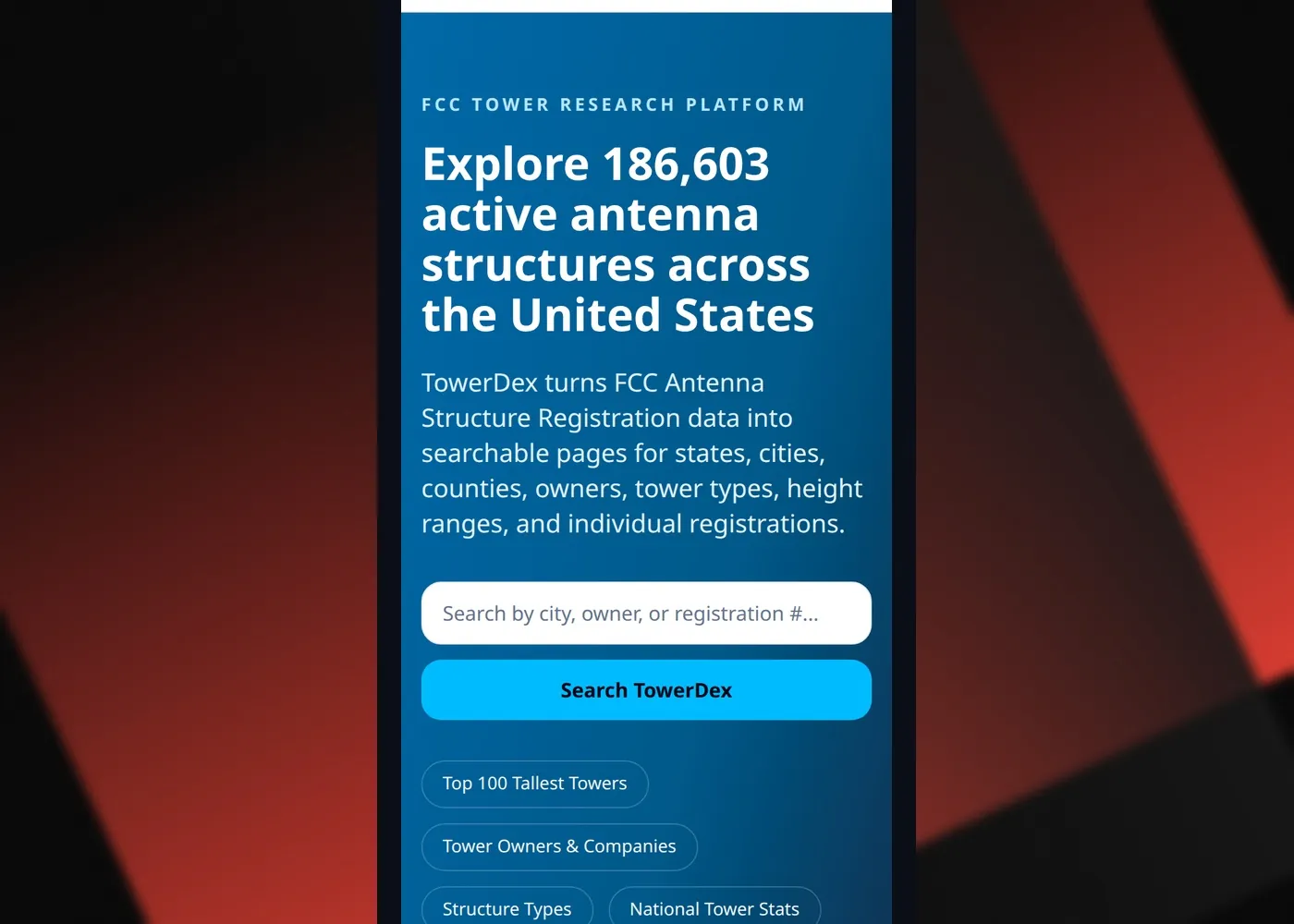
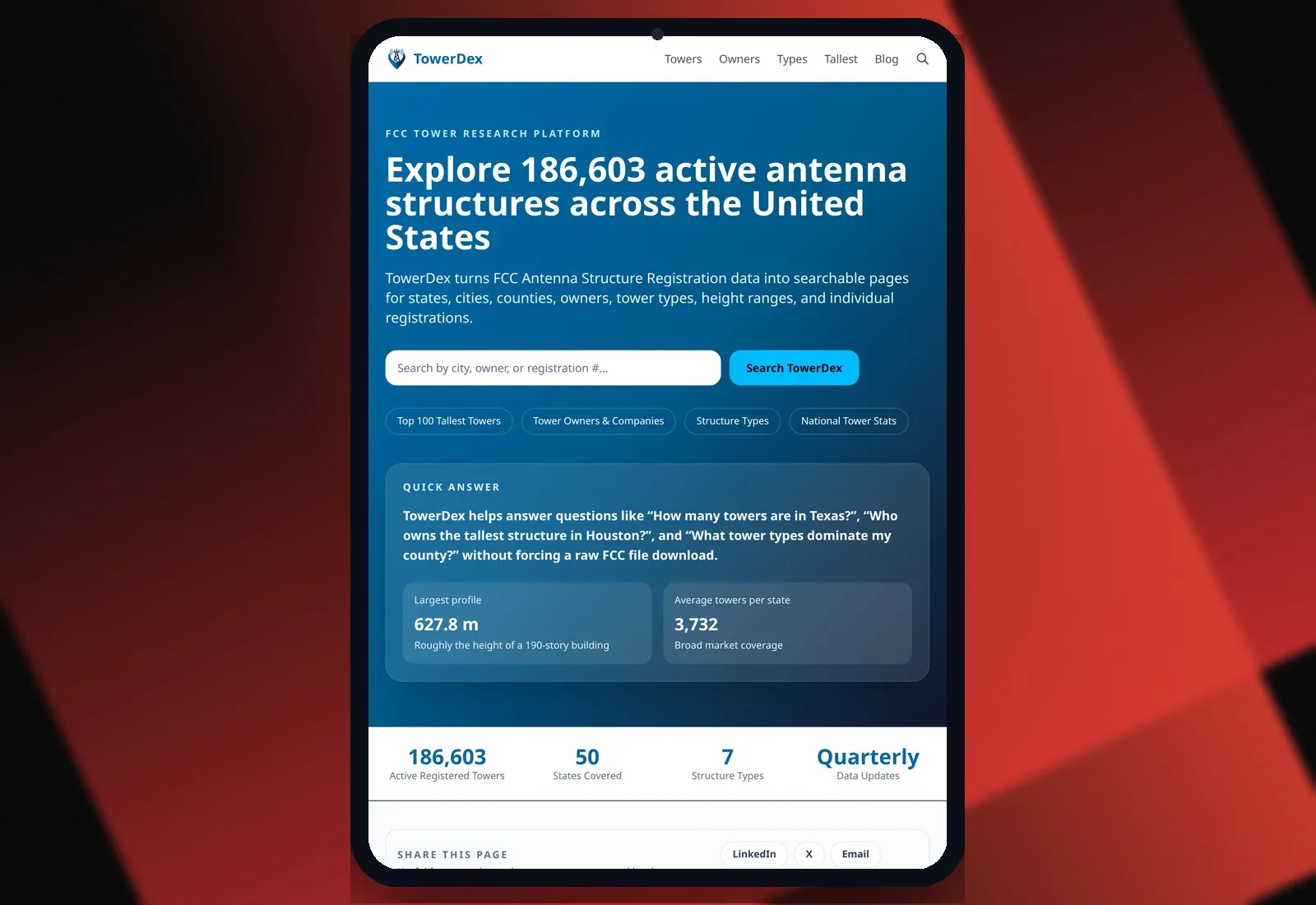
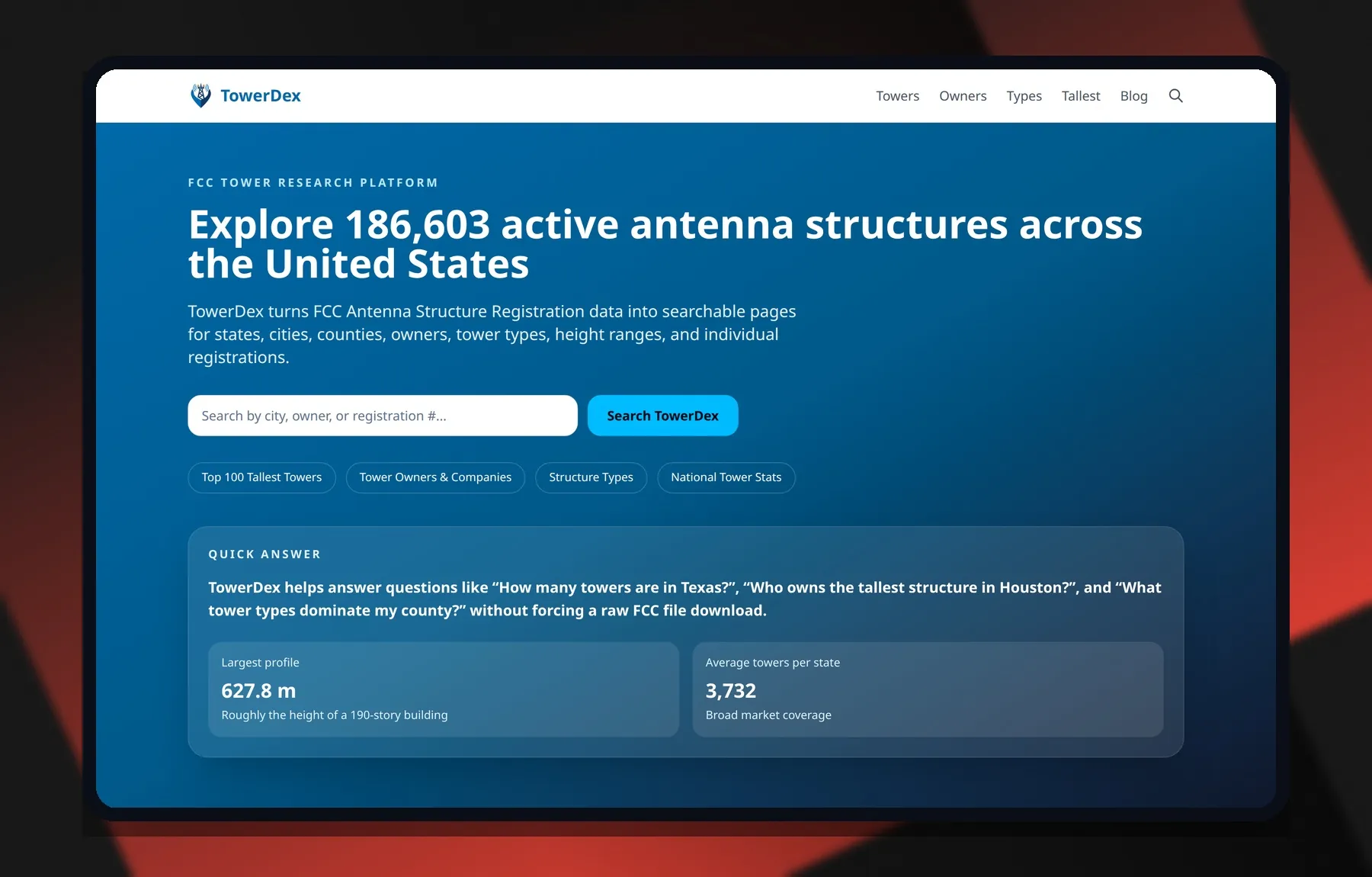
TowerDex is my answer to that problem. It is an own product from my network of sites: nobody commissioned it, there is no client behind it. I built it because the pattern interested me — a huge, valuable and practically inaccessible official registry — and because I wanted a data platform to test how far well-executed programmatic SEO can go. Every data point in the registry becomes a page that answers a concrete question: states, cities, counties, owners, tower types, height ranges and individual registrations.
What it lets you do
- Top-down geographic exploration. Open a state page, compare its main cities and counties and drill all the way down to each tower's individual record without losing the thread.
- Owner profiles. Complete tower portfolios per company, to understand who really controls the infrastructure in each market.
- Types and heights. Browse the registry's 7 structure types and height ranges, plus the Top 100 tallest towers in the country.
- Records with context. Each tower shows height, owner, construction status, FAA information and nearby structures, with links to its geographic pages.
- Direct search. Search by city, owner or registration number for anyone who already knows what they are looking for.
- Quotable answers. The main pages carry summaries, FAQs, comparisons and sourced metrics, written for classic search engines and answer engines alike.
- National stats and editorial content. State and structure-type rankings that put every figure in context, plus a blog that explains ASR terminology, FAA marking and the economics of building a tower.
How it is built
TowerDex is a custom build from end to end: no templates, no plugins and no third-party licences. These are the four pieces that hold it up.
1. Laravel architecture
- Laravel backend on PHP with MySQL as the only database. Routes and controllers per entity type (tower, owner, state, city, county, type, height range) and Blade templates reused across every variant.
- Frontend compiled with Vite, Tailwind for the visual system and Alpine.js for the few interactive behaviours that are actually needed. No SPA: server-rendered HTML, which is what a directory needs to get indexed.
- Maps with Leaflet to place each structure at its real location without depending on a paid map provider.
2. The data pipeline
- Ingestion of the raw ASR file and normalisation of its fields: heights, coordinates, construction statuses, structure type codes and FAA data.
- Owner deduplication, the most thankless job: the same group appears spelled several ways in the registry, and without consolidating it the tower portfolios never add up.
- Precomputed aggregates per state, city, county, type and height range, plus the tallest-tower and largest-owner rankings.
- Quarterly cadence synced with the registry refreshes, with timestamps on individual records when the data is available.
3. Programmatic SEO
- One URL per entity generated from the data itself:
/state/texas,/type/lattice,/height/30-100m,/tower/1038731. Hundreds of thousands of pages with a single template per family. - Structural interlinking: every page points upwards (its state, its county) and sideways (nearby towers, same owner, same type), so crawlers reach every corner of the directory.
- XML sitemaps regenerated with the pipeline, so each data refresh gets discovered without waiting.
- Schema.org and direct answers on the highest-value pages, with FAQs and summaries written to be quoted by answer engines.
4. Performance
- Queries against aggregated tables, never over the full dataset: a state page does not scan 186,603 rows, it reads a precomputed summary.
- Indexes and pagination designed around the real browsing pattern, and versioned assets with preloading so the first paint does not wait for JavaScript.
- Served behind a CDN, with optimised images and styles. A directory this size only works if every page loads fast; otherwise neither users nor crawlers ever reach the bottom.
Coverage and where the data comes from
The directory covers all 50 states with an average of 3,732 towers per state, although the real distribution is very uneven: Texas concentrates 19,849 structures, California 10,304, Florida 9,653, Ohio 7,937 and Georgia 7,462. By type, the generic "Tower" category dominates with 94,155 records, followed by lattice towers (34,919) and guyed towers (19,818). By height, the bulk of the stock sits between 30 and 100 metres (131,583 structures), while only 1,137 rise above 300 metres.
At the very top is the 627.8 m tower in Galesburg, North Dakota — some 2,059.7 feet, roughly the height of a 190-story building — owned by Parker Broadcasting of Dakota. On the ownership side, the registry's largest portfolios are CCATT LLC with 4,991 towers, Array Digital Infrastructure with 4,001 and Tillman Infrastructure with 3,180.
Every one of those numbers comes from the same place: the FCC's ASR registry. TowerDex cites it as the source on every page and makes clear that it is not affiliated with the Federal Communications Commission. The platform invents nothing; it orders the data, cross-references it and makes it readable.
The result
TowerDex turns a file almost nobody opens into a site where anyone can answer an infrastructure question in two clicks. It is used by researchers, planners, tower crews, local journalists and site acquisition teams, and it also covers the part of the funnel that raw data never reaches: long-tail searches by city, by owner or by structure type.
For me it is, above all, proof of a method I also apply to client projects: take a data source with real value, normalise it, and build on top an architecture that generates thousands of useful, indexable pages without writing them by hand. Laravel, MySQL, a disciplined data pipeline and programmatic SEO. No smoke and mirrors: the data leads and the platform simply serves it well.
A few screenshots
Stack
You can check every figure on this page live: Visit towerdex.com.
TowerDex frequently asked questions
Where does TowerDex's data come from?
From the public Antenna Structure Registration (ASR) system run by the FCC, the US telecommunications regulator. The platform is built around recurring refreshes of that registry, with quarterly data updates, so every page reflects real antenna structure records. TowerDex is not affiliated with the FCC.
What does each tower's record show?
Every individual record includes height, owner, structure type, FAA information and nearby structures, with internal links to its city, county and state pages so you can keep exploring the infrastructure map.
What is the tallest structure in the registry?
A 627.8 m (2,059.7 ft) tower in Galesburg, North Dakota — roughly the height of a 190-story building. TowerDex maintains a ranking of the country's 100 tallest towers.
Which states have the most registered towers?
Texas leads with 19,849 active structures, followed by California with 10,304, Florida with 9,653, Ohio with 7,937 and Georgia with 7,462. The national average is around 3,732 towers per state.
Can you see who controls the infrastructure in each market?
Yes. TowerDex generates a profile page for every owner with their full portfolio of structures. The largest in the registry are CCATT LLC with 4,991 towers, Array Digital Infrastructure with 4,001 and Tillman Infrastructure with 3,180.
Who is TowerDex useful for?
Site acquisition, aviation awareness, local journalism, infrastructure research, radio and broadcast market discovery and telecom competitor analysis — without forcing anyone to download a raw FCC file.
More own products
Other platforms of mine built on US infrastructure and public records.
Need something on this scale?
Custom Laravel, data pipelines and programmatic SEO at the scale of hundreds of thousands of pages. A free 30-minute call, no strings attached.
Request a free quote