Specialized in the insurance industry
Web design for insurance brokers
A brokerage lives on leads, and leads are born on Google now. I build websites for insurance brokers who genuinely compete online: custom comparison engines, centralized lead capture with full source attribution, and programmatic SEO capable of ranking hundreds of pages per carrier, product and region. For a brokerage from Madrid and Toledo I built a two-site ecosystem with over 1,600 optimized articles and thousands of programmatic pages feeding their comparison engine.
The usual problems with a brokerage website
Every one of these is a policy someone else signs.
You compete against the carriers themselves
When someone searches for insurance, Google shows them the big carriers and the major comparison sites. Without a serious SEO strategy, the brokerage simply doesn't exist at the exact moment the buying decision is born.
A brochure site that captures nothing
Who we are, which lines you handle, a phone number. Zero quote forms, zero lead magnets. Visitors arrive ready to buy a policy and leave without leaving so much as an email address.
Leads scattered with no attribution
One enquiry by email, another on WhatsApp, a call scribbled on paper. Without centralized capture you don't know which channel brings each lead, which ones die unanswered, or which campaign actually pays for itself.
Content that doesn't scale
Each product, carrier and region deserves its own page, because that's how people search: "health insurance + city", "provider network + carrier". Writing all of that by hand is unfeasible; not doing it means giving that traffic away.
Half-done regulatory compliance
Insurance distribution demands clear pre-contractual information (the EU's IDD), a visible regulator registration number and impeccable data handling under GDPR — even more so with health data. A website that ignores this is a regulatory risk, not a sales channel.
Dependence on third-party lead sellers
Buying leads from portals that keep the margin and the data is renting your acquisition. Every month without digital assets of your own, your business depends a little more on a supplier who can raise prices tomorrow.
What a well-built brokerage website includes
What I deliver when I work with a brokerage or an insurance agent.
Your own comparison and quoting tools
Custom-built tools where the visitor compares coverage or requests a price: the format that converts best in insurance, integrated with your real products and carriers.
Centralized lead capture
Every form on every page flows into one system, with UTM tracking that identifies the source, instant alerts to your team and your own dashboard to manage them. No lead gets lost or goes unattributed.
Programmatic SEO by product and region
An architecture that generates and maintains hundreds or thousands of unique pages (carrier x region x product, public-sector schemes like Spain's MUFACE) without writing them by hand and without duplicate content. That's how you compete with the big players.
IDD and GDPR compliance
Pre-contractual information, your regulator registration number visible (DGSFP in Spain), explicit consents, a compliant cookie layer and reinforced data handling wherever health data is involved. All drafted and configured at delivery.
Content that ranks and educates
An optimized blog covering coverage questions, comparisons and the real doubts your clients have, with FAQ schema to occupy more space on Google. Content is the asset that keeps capturing after you switch the ads off.
Integration with your CRM and your workflow
Leads land directly in your CRM or in the tools your team already uses, clean and classified by line of business. The website adapts to your operation, not the other way around.
Real case: two websites for a brokerage from Madrid and Toledo
A complete digital ecosystem for a brokerage specialized in health insurance: a comparison site with brand authority and a programmatic directory feeding it traffic.
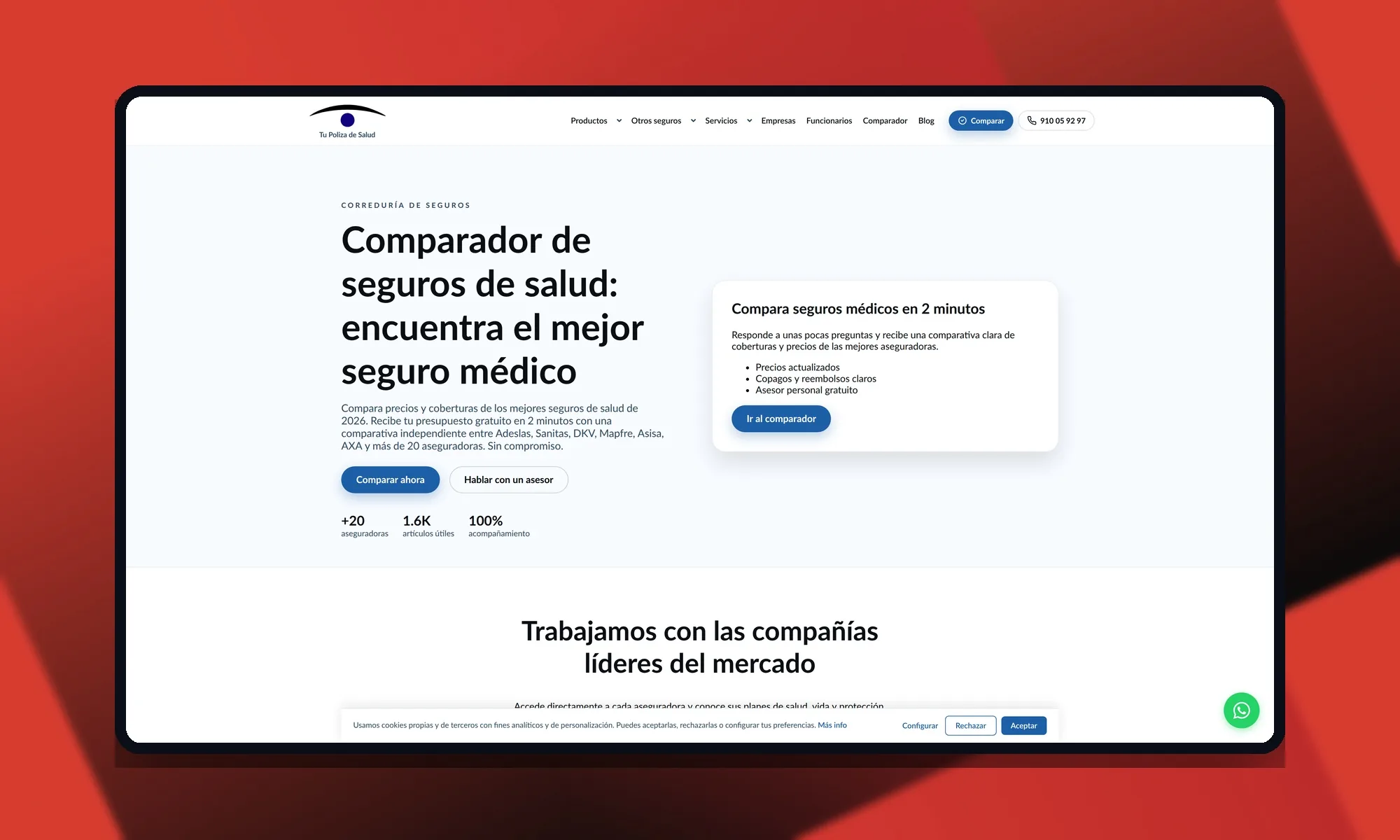
Tu Poliza de Salud
Rescued the site from a server with no access, rewrote the stack in pure PHP and improved the SEO of over 1,600 articles. More than 20 carriers integrated, centralized lead capture and a custom back office.
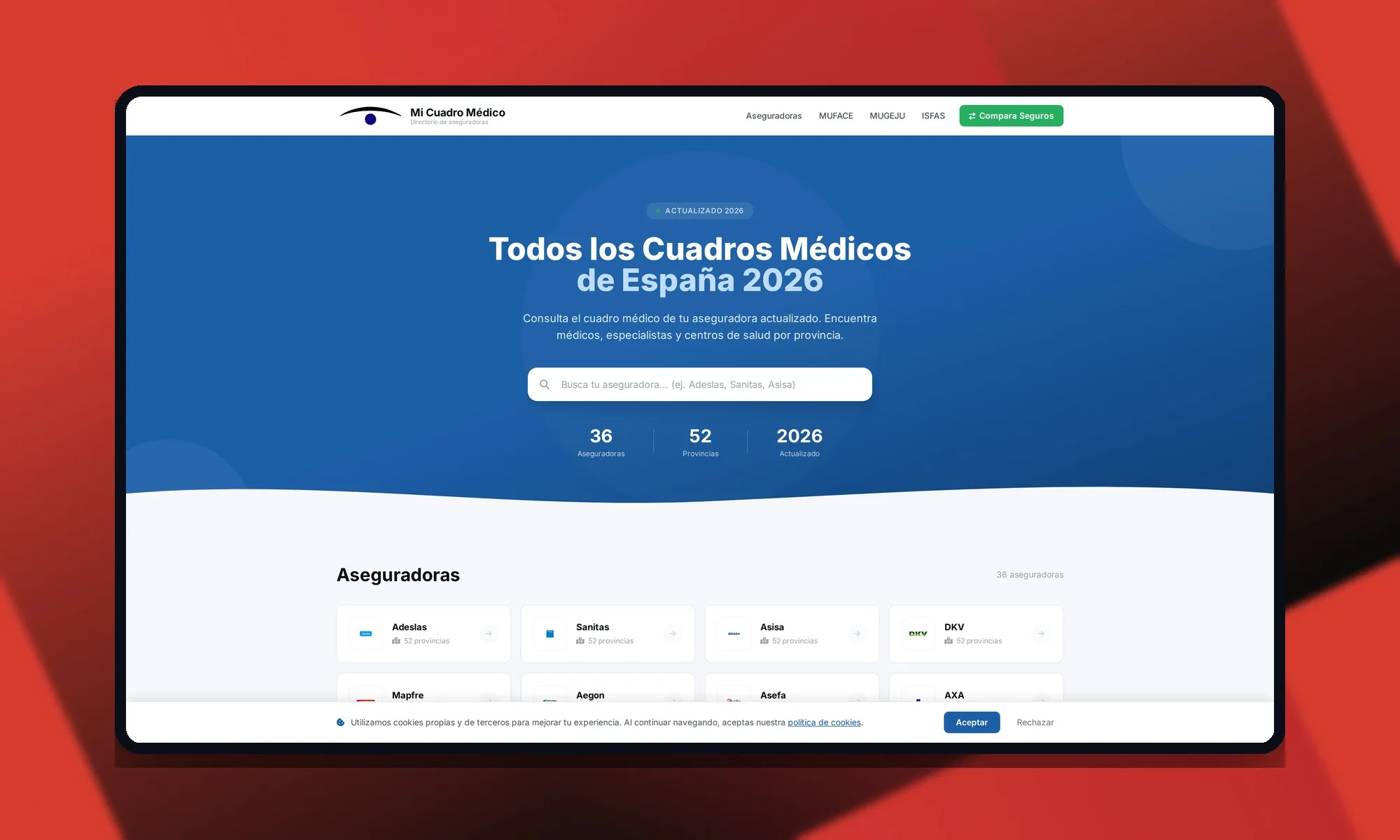
Mi Cuadro Medico
A nationwide medical-network directory with thousands of programmatic pages (carrier x province x specialty), public-sector schemes and AI-generated FAQs feeding traffic to the comparison engine.
How pricing works
Every project is priced by scope: pages, features, integrations, and deadlines. No inflated agency rates, no mid-project surprises.
After a 30-minute call, you get a fixed written quote within 24 hours, with deliverables and a timeline.
I take on a limited number of projects per year. I look for clients who want a long-term technical partner, not the lowest bid.
Frequently asked questions
How much does a website for an insurance brokerage cost?
It depends on scope: a corporate site with contact forms is not the same as a comparison engine with programmatic SEO and CRM integration. Every project is priced individually: after a 30-minute call I send you a fixed written quote within 24 hours, with concrete deliverables and deadlines.
How long until the website is ready?
A corporate brokerage site with lead capture is usually ready in 4-6 weeks. A comparison engine or a programmatic SEO project is planned in phases: first the foundation that already captures, then the scale. Each phase's timeline is locked in the quote.
Can you build a custom comparison or quoting engine?
Yes — it's my specialty in this industry. I develop custom comparison tools with your products and carriers, quote forms per line of business and whatever business logic you need, on PHP or Laravel. No third-party licenses: the tool is yours.
How are the leads the website generates managed?
Centrally: every form flows into one system with instant alerts to your team, UTM tracking that identifies the campaign and landing page, and a feed into your CRM if you already use one. You'll know exactly which channel brings each signed policy.
Will the website comply with insurance distribution rules and GDPR?
Yes. The site is delivered with the pre-contractual information required by the EU Insurance Distribution Directive (IDD), your regulator registration number visible (DGSFP for Spanish brokers), explicit consent on every form and a GDPR-compliant cookie layer. If you work health lines, data handling is reinforced as required for special-category data.
What is programmatic SEO and why does it work so well in insurance?
It means systematically generating unique, useful pages for every combination people search for: carrier by region, product by public-sector scheme, provider networks by specialty. Insurance searches are exactly that granular, and covering them by hand is impossible. With the right architecture, thousands of pages work around the clock capturing traffic that ends up in your comparison engine.
Can I compete on Google with the carriers and the big comparison sites?
Yes, by picking your battles: the carriers own their brand terms, but long-tail searches ("health insurance with a provider network in your region", "insurance for civil servants") are within reach of a brokerage with well-executed programmatic content. That's exactly the strategy behind the real case on this page, with thousands of indexed pages feeding a comparison engine.
I already have a website — can you migrate it without losing rankings?
Yes, even in extreme situations: I once rescued a brokerage's site from a server nobody had access to anymore, preserving and improving the SEO of over 1,600 articles. URL inventory, 301 redirects and post-migration verification are part of my standard process.
Other industries
Get a quote for your industry
Shall we talk about your project?
Tell me what you need and I'll tell you how I'd build it — fixed quote within 24 hours.
Request a proposal