OSHARecord
5.1 million OSHA workplace safety inspections turned into more than 600,000 searchable company profiles. A US public-data directory I conceived, built and operate within my own network of websites, powered by Laravel, MySQL and programmatic SEO.
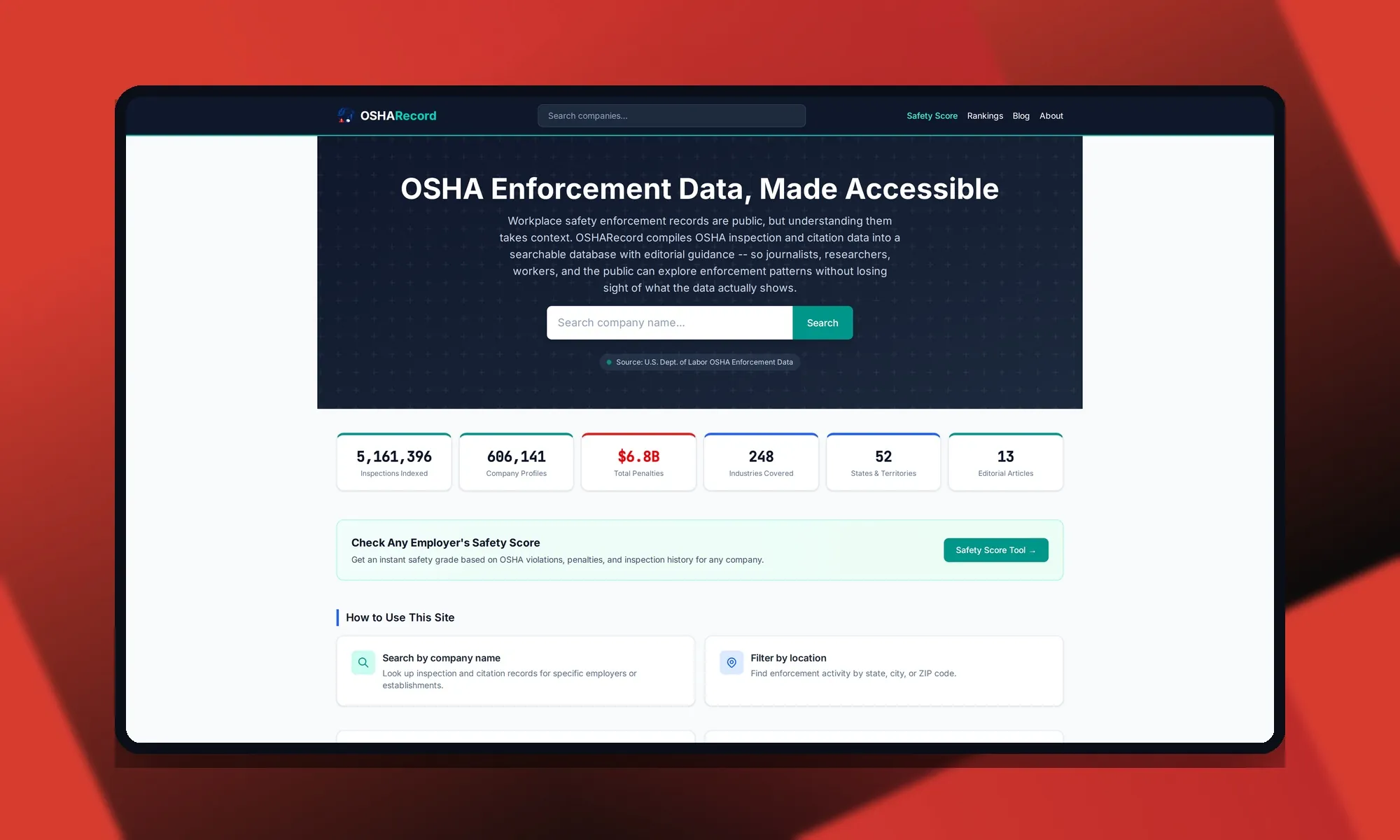
Why it exists: public data nobody could read
The workplace safety case files of OSHA (the US Occupational Safety and Health Administration) are public, but making sense of them takes context: the U.S. Department of Labor publishes them as massive bulk dumps, full of agency codes, duplicate establishments and no aggregated view per company. If a journalist wants to know how many times a specific employer has been fined, they are in for an afternoon of wrestling with raw files.
OSHARecord solves exactly that: it compiles inspection and citation data into a searchable database wrapped in editorial guidance, so journalists, researchers, workers and safety professionals can explore enforcement patterns without losing sight of what the data actually shows — and what it doesn't.
This is not client work: it is a product of my own network of websites. I conceived it, designed it, coded it and operate it end to end, from the data model to the search-engine strategy. That context matters, because every technical decision in the project was made so the platform can run on its own, with no team behind it.
What it lets you do
- Company search. Inspection and citation histories for any employer or worksite, grouped into company profiles with real-time search.
- Safety Score. An instant safety grade calculated from the employer's violations, penalties and inspection history.
- Location filters. Enforcement activity by state, city or ZIP code, across 52 states and territories.
- Violation classes. Browsing by type: serious, willful, repeat or other-than-serious.
- Industry rankings. Benchmarks across the 248 industries covered.
- Editorial context. Articles explaining how to interpret enforcement data responsibly, without cheap headlines.
How it's built
1. Laravel architecture
- Laravel + PHP backend on MySQL: no WordPress, no themes — the entire data model and every view are custom-built.
- Livewire for the reactive components: company search responds in real time as you type, without bolting on a separate SPA.
- Vite for the frontend, with versioned, preloaded assets.
2. Data pipeline
- Ingestion of the official dumps from the U.S. Department of Labor's OSHA enforcement database.
- Normalization and grouping: establishment-level records are consolidated into browsable company profiles — from millions of raw rows down to 606,141 profiles.
- Safety Score calculation per employer, based on violations, penalties and inspection history.
3. Programmatic SEO
- Every inspection, company and industry generates its own indexable page, with titles, metadata and structured data produced automatically from the data model.
- Internal linking at scale: profiles link to their inspections, industries link to their companies, and rankings channel authority down to the deep pages.
- Supporting editorial content (pillar articles and a blog) providing the context the data pages cannot deliver on their own.
4. Performance
- MySQL tuned for massive reads: indexes designed to serve hundreds of thousands of company and inspection pages with minimal load times.
- Search that stays fast across 5.1 million inspection records, with debouncing and tightly scoped queries.
- No-team operation: the platform is designed to run unattended, with no dependencies that need daily babysitting.
Coverage and data sources
The source is the OSHA enforcement database of the U.S. Department of Labor, and the site's own homepage shows the scale of the index: 5,161,396 inspections, 606,141 company profiles, 6.8 billion dollars in accumulated penalties, 248 industries and 52 states and territories.
Coverage runs from case files dating back to the early nineties to inspections opened just weeks ago. Among the featured records is BP Products North America in Texas City (2005), with more than 21 million dollars in penalties — the largest on the platform.
The outcome
OSHARecord is the practical proof of what I sell as a service: turning official multi-million-row dumps into more than 600,000 browsable pages that rank on their own. There is no advertising and no campaigns behind it — the programmatic pages do the acquisition work by themselves, and the real-time search handles the volume without breaking a sweat.
It is also the centerpiece of a family of US public-data directories I build with the same recipe: MshaScan (mine safety), PollutionScan (environmental violations) and WARNScan (mass layoffs). Same pattern — official dataset, Laravel, programmatic SEO — applied to different domains.
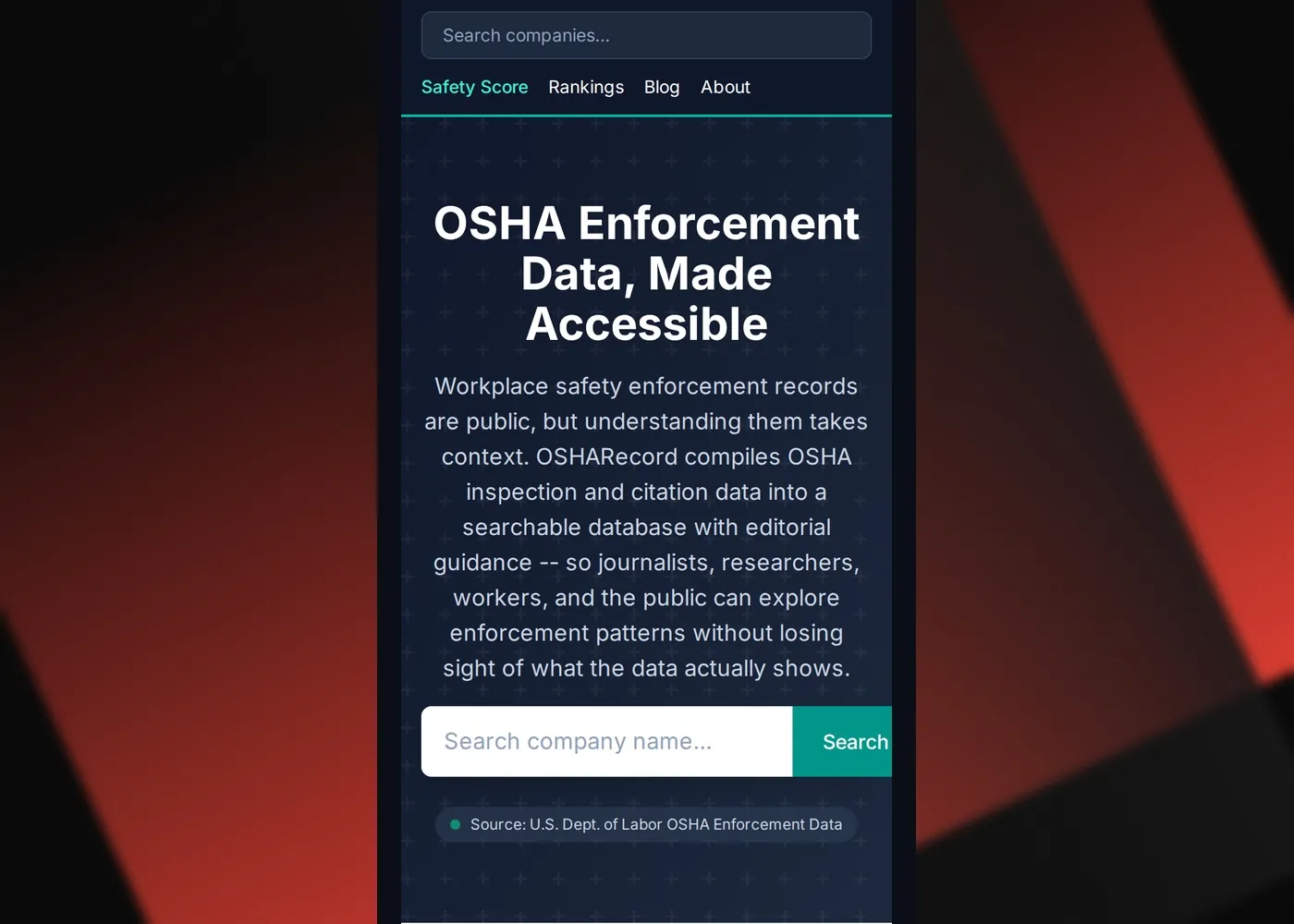
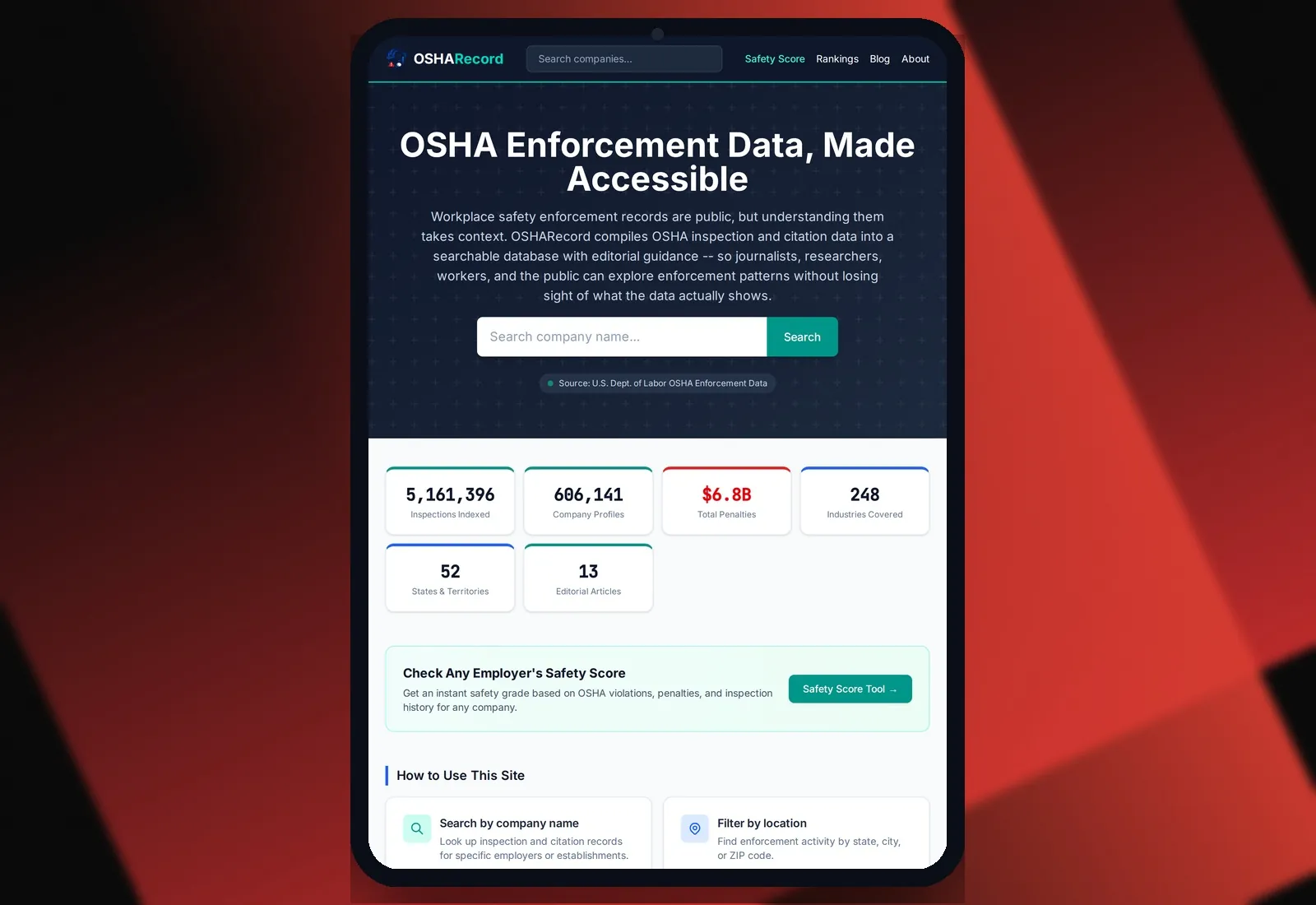
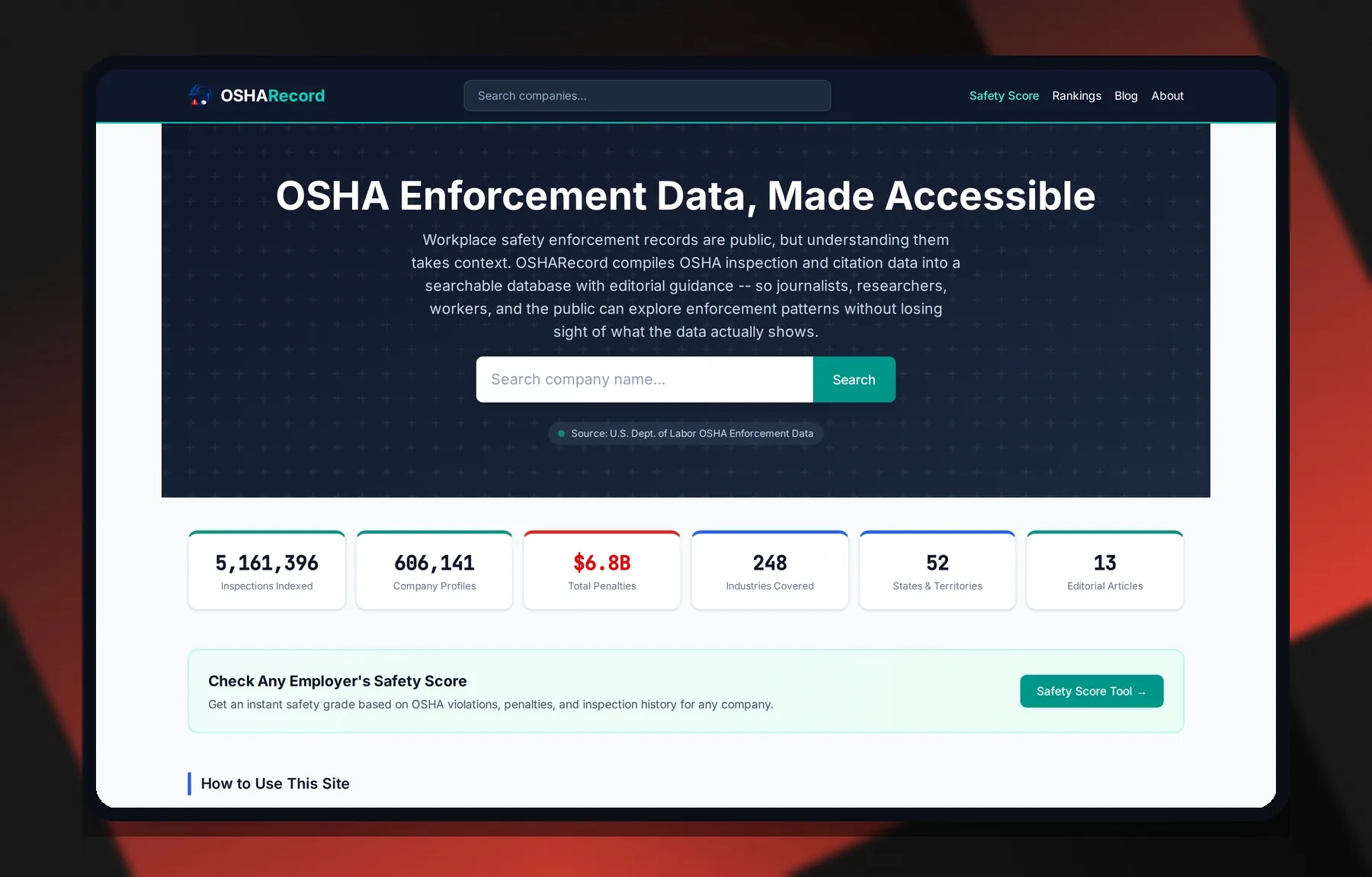
A few screenshots
Stack
Live product: Visit osharecord.com — the homepage counters can be checked live.
Frequently asked questions
Where does OSHARecord get its data?
From the public OSHA enforcement records published by the U.S. Department of Labor. The platform indexes them and organizes them into searchable company profiles.
What is the Safety Score?
An instant workplace safety grade that condenses any employer's violations, penalties and inspection history into a single rating.
How many inspections does the platform cover?
Over 5.1 million inspections indexed, with 606,000 company profiles, 248 industries and coverage across 52 US states and territories.
Who is a tool like this for?
Journalists, researchers, workers and safety professionals who need an employer's safety history without wrestling with raw government databases.
What is the largest penalty on record in the platform?
The featured case with the highest penalty is BP Products North America in Texas City (2005), with over 21 million dollars in fines. The index spans case files from the early nineties up to inspections opened just weeks ago.
Is it built with WordPress or a template?
No. It is a custom build with Laravel, Livewire and MySQL, with every company, inspection and industry page generated programmatically from the data model itself.
More of my own products
Got data you want to turn into traffic?
Laravel, data pipelines and programmatic SEO at scale. A free 30-minute call, no strings attached.
Request a free quote